Hugo has kindly posted his Tai Chi story. John always cites him as the student, from amongst the 10,000 or so that John has taught, with the very best heart, so quite a person. If you're reading this Hugo I'd like to hear the story of how you met Issey Miyaki and the consequent change in your life. The version I heard has been a constant inspiration to me.
15 September 2005
14 September 2005
Courage & Softness
I am little interested in whether a student shows courage in anything other than the only fight I consider worthwhile which is the one with the ego, the one with what it is that prevents the heart from manifesting in every particle of that person. People who practice their courage through dangerous activities are as far from this as anyone, their courage is so often just a hard skin they have erected around their fundamental fear: the fear of being connected to others: the fear of heart; and their false courage is actually an impediment to their ability to connect and show compassion. Take a look at the average US soldier to see evidence of this. If the courage you are practising doesn't make you softer to the touch then it is false courage.
The fundamental problem in Tai Chi and Heartwork - the thing that unifies these two quite different disciplines - is yielding. How do you respond to energy coming towards you in such a way that you do not inhibit it and do not get knocked off balance by it? How do you join with it and use it to thrust you more energetically into your life and destiny? What interests me about thunder for example is the fact that all children are frightened by it, as I was, and that the more Tai Chi I do the more I am becoming yet again frightened by it, I just realise now that the fear I feel is an aspect of my energy waking up. A scientific, religious or other explanation of what thunder is simply helps me ignore my energetic responses - it encourages me to cut off from what is actually happening, energetically, between me and the thunder. Fear cannot really be rationalised away.
The more Tai Chi I do and the more time I spend with my teacher the more I am convinced that the only way forwards in life (real yielding) comes through compassionate (unselfish) interactions with others, from putting others first. This is not easy: by all accounts Mother Teresa was as hard as nails to the touch - a sure indication that she got it wrong; to go out of your way to do good is just as much an ego-trip as anything else.
Softness and compassion are very similar. A soft touch is one that lingers and enters, with an opening, welcoming, searching and gracious heart (John Kells). If this doesn't manifest in the quality of the touch then it isn't happening.
Tai Chi and Heartwork are in fact simple and straightforward. You just need the intelligence to start and the courage to continue. You learn to love and admire your teacher and you learn to love and assist your companions. All of you have something to offer and all of you progress. The communal heart. The living heart.
The fundamental problem in Tai Chi and Heartwork - the thing that unifies these two quite different disciplines - is yielding. How do you respond to energy coming towards you in such a way that you do not inhibit it and do not get knocked off balance by it? How do you join with it and use it to thrust you more energetically into your life and destiny? What interests me about thunder for example is the fact that all children are frightened by it, as I was, and that the more Tai Chi I do the more I am becoming yet again frightened by it, I just realise now that the fear I feel is an aspect of my energy waking up. A scientific, religious or other explanation of what thunder is simply helps me ignore my energetic responses - it encourages me to cut off from what is actually happening, energetically, between me and the thunder. Fear cannot really be rationalised away.
The more Tai Chi I do and the more time I spend with my teacher the more I am convinced that the only way forwards in life (real yielding) comes through compassionate (unselfish) interactions with others, from putting others first. This is not easy: by all accounts Mother Teresa was as hard as nails to the touch - a sure indication that she got it wrong; to go out of your way to do good is just as much an ego-trip as anything else.
Softness and compassion are very similar. A soft touch is one that lingers and enters, with an opening, welcoming, searching and gracious heart (John Kells). If this doesn't manifest in the quality of the touch then it isn't happening.
Tai Chi and Heartwork are in fact simple and straightforward. You just need the intelligence to start and the courage to continue. You learn to love and admire your teacher and you learn to love and assist your companions. All of you have something to offer and all of you progress. The communal heart. The living heart.
13 September 2005
Faith Courage Sincerity
Liang Tung Tsai, my teacher's first great Chinese Master, had many catch-phrases. Perhaps the most perfect of them is the one he used once to describe a student who claimed to know when he didn't: "Worse than a beginner". Akin to Pope's "A little learning is a dangerous thing", it is perhaps the most damning thing a teacher can say about a student. It implies that the student is closed to new instruction because they feel they already know; it also implies that the knowledge the student has acquired has been misinterpretted and has remained shallowly in the head and failed to transfer to body and energy. This can only be the case if the student has failed to do sincere practice. Sincere practice is the struggle to do precisely what the teacher has instructed, solely to become better connected to the lineage and teaching. If the student's practice is not sincere then it is up to the teacher to point out where the insincerity lies: the student may not be listening on the level required, may be incorrectly motivated, or may simply be a bit stupid, all of which can be corrected. My teacher has often said to me that sincere and earnest are not the same. An earnest student is one who engages in good honest hard work through which there runs a streak of sincerity, but who isn't quite connected to the source of it all; along with that streak there is also a swath of anxiety and blindness,and therefore weakness. Wynton Marsalis once described John Coltrane as earnest, which is a perfect description. Sincere implies that the purity runs through and through. This can only be the case if the student is, at core, relaxed and connected to a well of purity. This is faith. Courage is what allows it all to develop and pan out into a life of significance and meaning.
12 September 2005
11 September 2005
Terror
The whole idea of this weblog is that it gradually build up a picture of what it means to study, research and live, full-time, a great ancient lineage under a great master with whom I live (albeit in separate quarters). Such a situation is very rare nowadays, and is a great privilege and luxury (I must have done something right in a past life to deserve it), and I figure my experiences and thoughts may therefore be of interest to those studying the same or similar paths part-time with only occasional exposure to their teacher. The organic blog format is ideal since it allows me to jot down things as they come up, rather than having to somehow weave them all together into a unified finished article. I intended this to simply be a little inspiration to my students and comrades: through sharing to somehow put the work into the broader context of the teaching, highlighting areas where a modern mind can go astray. Very little of what I say comes from the place of ratiocination and any clumsiness or imprecision is the product of my irresolute, though gradually resolving, heart and my somewhat vain attempts to elucidate aspects of energy we have no adequate language for. There is no room or time for idle questions or argument. If that part of the mind surfaces then one has momentarily slipped out of the river of knowledge and it's time to get back in. The students I value and admire most, those like Ann and Ray, wear their fear and suffering on their sleeves yet still have the courage and conviction to put themselves in the way of the teaching, no matter the intense discomfort (terror) it induces. They know they have no choice. They also know that the only way forward is through belief, which, if you like, is the heart knowing rather than the head. When the teaching opens up before a good student they feel terror because the whole thing is impossible: to step into that would be madness, and yet they do, and because they do, because they find the courage despite their feelings, they receive the grace to continue. One must fear God to receive his grace. The fear or terror is simply a sincere response to openness. If you don't feel the fear then you're not open, not to the abyss the teaching presents anyway. With experience one grows to love the terror, after all it's the feedback one needs. It's the stimulus that kick-starts those aspects of your energy required to take the plunge. It's what makes you a warrior.
10 September 2005
Going deeper

When I was a kid I spent much of my time ill with asthma and consequent secondary infections such as bronchitis, laryngitis, etc. On one occasion, when I was about 12, my father came into the bedroom and told me he was going to the library and did I want any books. I said to just get something that looks interesting. He came back with three books, all mongraphs, on Paul Klee, Wassily Kandinsky and Karlheinz Stockhausen. I remember leafing through them and marvelling that there were whole worlds out there I had no notion of. Reading the Stockhausen book, the author kept referring to the trinity of Schoenberg, Berg and Webern, all names new to me. I turned on Radio 3 and playing was Schoenberg's Opus 31. "This is meant to be", I thought.
Yesterday my teacher showed me an energy I had no idea even existed. It required a relaxation I had never touched before. "Your soul must relax, into your destiny", he said. I had that same awestruck sensation I had at 12: there are whole worlds out there I am not party to. The feeling was that at some level (in the mind) I stopped clinging on and slipped into a larger world, a world that contains the one I'm used to but is far vaster. I know I have drifted in and out of this energetic reality before but it required someone who knows to point out certain landmarks in its environment, and a means of entry, for me to register it as a place to reside. Experience has shown me that there is always a world beyond the one you're in and that the work at hand, rather than consolidating your gains, should be unsettling you sufficiently to be disatisfied with where you are and building up the grace to allow entry into the next.
In one sense we are all equal, in God's eyes anyway, however we are not all at the same level. Some people are spiritually more advanced than others, i.e. they exist within a higher (larger) energetic space than others. As a smaller space is nested within a larger one, so a spiritually advanced person naturally allows a less advanced person into their larger heart - this is compassion. In the presence of a master it is important to relax into their presence and allow yourself to nestle into their heart otherwise you will learn nothing. This may be a terrifying prospect and, if you are master and teacher yourself it may take some time to slot into, but it will only be difficult if your own work is not taking you deeper. The work is not about fortifying your enclosure but about becoming more open and more vulnerable.
Yesterday my teacher showed me an energy I had no idea even existed. It required a relaxation I had never touched before. "Your soul must relax, into your destiny", he said. I had that same awestruck sensation I had at 12: there are whole worlds out there I am not party to. The feeling was that at some level (in the mind) I stopped clinging on and slipped into a larger world, a world that contains the one I'm used to but is far vaster. I know I have drifted in and out of this energetic reality before but it required someone who knows to point out certain landmarks in its environment, and a means of entry, for me to register it as a place to reside. Experience has shown me that there is always a world beyond the one you're in and that the work at hand, rather than consolidating your gains, should be unsettling you sufficiently to be disatisfied with where you are and building up the grace to allow entry into the next.
In one sense we are all equal, in God's eyes anyway, however we are not all at the same level. Some people are spiritually more advanced than others, i.e. they exist within a higher (larger) energetic space than others. As a smaller space is nested within a larger one, so a spiritually advanced person naturally allows a less advanced person into their larger heart - this is compassion. In the presence of a master it is important to relax into their presence and allow yourself to nestle into their heart otherwise you will learn nothing. This may be a terrifying prospect and, if you are master and teacher yourself it may take some time to slot into, but it will only be difficult if your own work is not taking you deeper. The work is not about fortifying your enclosure but about becoming more open and more vulnerable.
09 September 2005
Principle
What gives my teacher his uncompromising intensity is his fascination with principle. A principle is a piece of knowledge that applies everywhere and that should therefore be internalised through practice. The practice aims to embed the principles so firmly within your being that they become natural to you. The principle that has been uniquely my teacher's focus and which I believe has led him to Heartwork via the figure of eight is cross-energy. Cross-energy is all about connexion: left foot to right hand, right foot to left hand. If you need to use one hand and then quickly the other you must use each root in turn which means your feet can't be too far apart: the feet need to be engaged with each other as well as with the ground. Cross-energy is all about translating energy from one place to another through interaction: communication. There are two crossing lines - X - the double aspect of things. There are four limbs - the double aspect of the double aspect: doubling-up: binary proliferation. If the top two limbs curl to touch each other and similarly the bottom two limbs then X becomes 8 and we have a figure of eight: unity with a twist. Where the two stems of the X touch we have a heart. When the limbs begin to curl we have ward-off. Ward-off is the simultaneous acceptance and issuance of energy: the hollow chest (or groin) receiving energy and the spreading shoulders (or hips) issuing energy down the embracing limbs: yielding contains attack. Ward-off is also in the hand and foot, the middle accepting and the rim (particularly heel and digits) issuing. Ward-off is the way you approach everything, your loved ones, your enemies, strangers, daunting prospects: accepting but gripping. The energy that issues comes from behind, from that strange place, and can instantly engulf distance and time. When the situation is dangerous just show a little more teeth.
08 September 2005
Ward-Off
The Other Body I talked about below (03/09/05) is very important. John has likened it to a guardian angel. It is an aspect of your energy that resides behind you, looking over you protectively and engagingly, connecting and guarding. Ward-Off is simply a posture that stimulates and activates this guardian. In a true Ward-Off the arm should stem roundly and firmly from the back heart, the inside shoulder (around the clavicle) should be soft and empty, the mid-palm should face your sternal notch and the hand should be torqued, i.e. should feel as though it is twisting palm upwards to counter its natural inclination to turn palm downwards. Your head should crouch slightly between your shoulders with the feeling that the hump of the upper-back rises very slightly. This should make the hairs on the back of your neck bristle and bring a tingle to the crown of the head: sure signs that the energy behind is activated. As you retrieve Ward-Off at the beginning of every posture of the Form, the rounding and stretching shoulders should bring some of this behind-energy around and into the action. The crouching, tingling head brings some of the energy over the top and the sinking and hooking coccyx brings some under and up. You have thereby pincered the opponent on the horizontal and vertical planes. With practice this Ward-Off engagement becomes so familiar that a little of it is with you at all times, and its full intensity can be activated at the drop of a hat. When you get to this stage then your practice, your life of Tai Chi, engages with the real enemy which my teacher has always said is time. Not just ageing (though it is essential to tackle that if you wish to finish your work) but the linear, plodding, inexorable grip that time has us in, or rather, which we have conditioned time to be. Your daily practice gradually builds up an energy which relaxes into time as you relax into the energy and temporal events begin to bleed into each other just as much as spatial ones do. A Tai Chi life is one yielding to time.
07 September 2005
Healing Rain
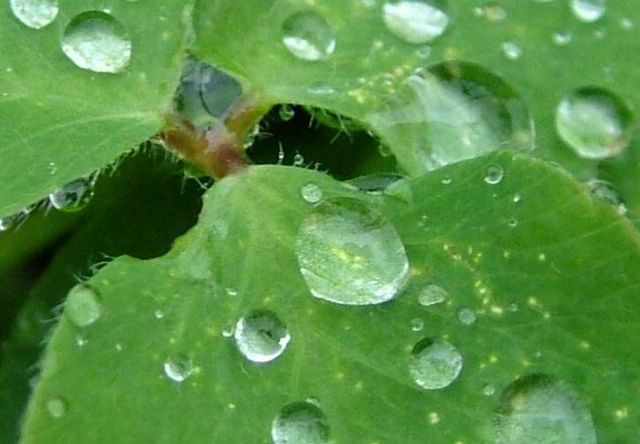
There’s an old exercise of John’s I resuscitated the other day. I think he called it Raindrops. The two of you should stand opposite each other, one with their eyes closed (‘the yielder’) and the other (‘the attacker’) with eyes open. (It helps if you're both naked though it's not essential.) The idea is that the attacker gently and lightly touches the yielder anywhere on their body (as lightly as a raindrop). The yielder should then rush their mind and energy to that point. If the attacker keeps contact then she should be able to feel this rush, or should certainly be able to feel a change taking place in the quality of the touching interface as the yielder’s energy gathers there. If the energy is strong and the attacker is sensitive then this rush may even uproot the attacker. A Heartwork elaboration of this exercise would be to send the energy to the spot with the heart rather than the mind. If this happens the energy will travel as a stretching and clawing ‘hand’ to embrace and engulf the touching spot rather than simply bounce into it. This exercise will develop the compassionate heart which will eventually become nimble enough to rush anywhere it is required. This is especially useful if you, or a loved one, has any niggling injuries, pains, bad memories, etc. Let your heart energy reside in the injured spot with its characteristic pumping (embracing and consuming) and the healing process will quicken.
06 September 2005
Foot and hand
Pat asked me about the action of the foot in the walking exercise I outlined below. It is crucial to the whole exercise, and to the whole of Heartwork really (every part of Heartworld mirrors every other part and so all are crucial - all are alive and all are connected). The foot and the hand are really six pronged instruments, the five toes/fingers and the heel. As the foot stretches these stretch away from each other and as the foot curls up they curl towards each other, but not by collapsing but by stretching further (as though the foot or hand is trying to stretch around a largish globe or ball). It is easy to feel in the toes/fingers and not quite so obvious in the heel, which is consequently where we need to concentrate most. As the stretching foot hits the ground the heel should dig in and claw forwards by sinking the coccyx down into it (this keeps the bum in) and this action should feel that it triggers the clawing in the toes which stretch further as their tips pull towards the hook of the heel. The coccyx should feel alive and want to wriggle down the leg into the heel. Always struggle to make each part of your body, and each aspect of yourself, alive: i.e. with heart (which manifests in pumping movement) and a degree of independence from other parts. You whole being is a society or ecology of interdependent living entities, coordinated by your heart, which echoes through the hearts of all your parts. You obviously work best as a coordinated being when the parts cooperate towards the same end, however what gives you texture and magic is when you have the courage to allow all these parts and aspects the freedom to follow their own heartfelt agendas. Destiny rather than ambition.
04 September 2005
Blake
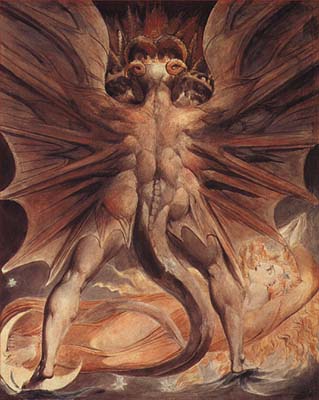
Busy this weekend with teaching so I'll post an email I got from Pat earlier today. She's one of the few truly educated people I know.
Leafing through Blake to check something, I found, as I always do, quotes that encapsulate Tai Chi Heartwork concepts. Nature's cruel holiness reminds me of what you wrote about the difficulty of being ruthless. At the last Intensive you were saying you should have said what you meant to Gillian, and to me that seems part of what Blake was getting at when he constantly warned of the dangers of splitting contraries. It takes you by surprise at first when you read that Satan had too much pity, but his sin was trying to have only the pity, without the accompanying wrath:
Changing the subject - I did a Yang style this morning, chanting hungalilihung rhythmically throughout, and making the movements fit the sound. It slowed me down, and changed the way I did the postures. Interesting.
Leafing through Blake to check something, I found, as I always do, quotes that encapsulate Tai Chi Heartwork concepts. Nature's cruel holiness reminds me of what you wrote about the difficulty of being ruthless. At the last Intensive you were saying you should have said what you meant to Gillian, and to me that seems part of what Blake was getting at when he constantly warned of the dangers of splitting contraries. It takes you by surprise at first when you read that Satan had too much pity, but his sin was trying to have only the pity, without the accompanying wrath:
And Satan not having the Science of Wrath, but only of Pity,The opposite of this is Beulah. (For Blake, the spiritual qualities manifest themselves in time and space, as places, individuals, nations etc., sometimes with the same name, sometimes not - confusing until you get the hang of it.) So
Rent them asunder, and wrath was left to wrath, & pity to pity.
...
The Separation was terrible.
There is a place whereBeulah is a kind of Garden of Eden, the next spiritual stage up from everyday life, which we reach sometimes, I believe he meant.
Contraries are equally True;
This place is called Beulah
Changing the subject - I did a Yang style this morning, chanting hungalilihung rhythmically throughout, and making the movements fit the sound. It slowed me down, and changed the way I did the postures. Interesting.
03 September 2005
The Other Self
When practising Tai Chi or Heartwork always try to be aware that as well as training in a new way of doing things, you should be trying to wake up to the fact that this new way is the natural way: it's the way your body and energy wants to do things when tensions are removed.
I was thinking in particular of the walking exercise below. Victoria has just gone on an 8 day walking holiday and I suggested she practice this exercise. She pointed out that her feet were really tired from the half hour we'd done together last Thursday (I must admit, so were mine) and that 6 to 8 hours a day of it would be impossible. Physically impossible I agree but energetically and internally I'm not so sure. This was something my teacher had to contend with very early on since he was driven to practice all hours of the day, most of which was time of absolute physical and mental exhaustion. So if you don't have the physical energy or the mental energy to do something then how do you do it? There is a larger part of you, operating in a different world of energy and connectedness, that can and will take over if it's given the opportunity. Relaxation is just the state you need to be in to connect with this larger part of yourself, it has nothing to do really with a lack of physical tension, it is more a resigned willingness to acknowledge that intelligence and knowledge reside somewhere other than the mind and body. So to practice 8 hours straight of anything one will need to relax, settle and open to this other self and allow it to take over. Your body and mind then ride it like a horse. This is why at Intensives we would do 2 hours without a break of Form: to try and reach that stage of the other body taking over. Those of us with a feeling for this were reluctant to stop because there is an inexorable choiceless quality to this other reality which is difficult to resist. A good teacher, by hook or by crook, will make you connect to this aspect of yourself - by encouragement, persuasion or bullying (I've known my teacher slap students quite hard across the face to bring it about). Without being connected to this the postures of Tai Chi are pretty meaningless and concentrating on technical niceties will simply avoid the issue. The Tai Chi should wake you up to this larger part of yourself. It will only do so when the mind empties not just of idle thoughts but also of the Tai Chi itself. This is not accomplished by numbing the mind (sinking into a stupor) but by entering the spirit of the postures and allowing them to breath life and enthusiasm into your slumbering higher self. Your practice then informs not just your Tai Chi but all aspects of your energy and life.
I was thinking in particular of the walking exercise below. Victoria has just gone on an 8 day walking holiday and I suggested she practice this exercise. She pointed out that her feet were really tired from the half hour we'd done together last Thursday (I must admit, so were mine) and that 6 to 8 hours a day of it would be impossible. Physically impossible I agree but energetically and internally I'm not so sure. This was something my teacher had to contend with very early on since he was driven to practice all hours of the day, most of which was time of absolute physical and mental exhaustion. So if you don't have the physical energy or the mental energy to do something then how do you do it? There is a larger part of you, operating in a different world of energy and connectedness, that can and will take over if it's given the opportunity. Relaxation is just the state you need to be in to connect with this larger part of yourself, it has nothing to do really with a lack of physical tension, it is more a resigned willingness to acknowledge that intelligence and knowledge reside somewhere other than the mind and body. So to practice 8 hours straight of anything one will need to relax, settle and open to this other self and allow it to take over. Your body and mind then ride it like a horse. This is why at Intensives we would do 2 hours without a break of Form: to try and reach that stage of the other body taking over. Those of us with a feeling for this were reluctant to stop because there is an inexorable choiceless quality to this other reality which is difficult to resist. A good teacher, by hook or by crook, will make you connect to this aspect of yourself - by encouragement, persuasion or bullying (I've known my teacher slap students quite hard across the face to bring it about). Without being connected to this the postures of Tai Chi are pretty meaningless and concentrating on technical niceties will simply avoid the issue. The Tai Chi should wake you up to this larger part of yourself. It will only do so when the mind empties not just of idle thoughts but also of the Tai Chi itself. This is not accomplished by numbing the mind (sinking into a stupor) but by entering the spirit of the postures and allowing them to breath life and enthusiasm into your slumbering higher self. Your practice then informs not just your Tai Chi but all aspects of your energy and life.
Added resistance
For about 10 years now we have been wearing hand, wrist and ankle weights when we work, plus a weighted belt. These add a little resistance to our movements and develop strength and sobriety. The belt is particularly useful; we use the Reebok Ironwear one since it can be adjusted at the back so that much of the weight bears down on the sacrum, encouraging it to stay in and down. The weight of the belt can also be adjusted - it's possible to start light and work up over months and years to the full 10lbs. The German company linked to above I've found very good; if the order is over £70 (I think) the postage is free. If you give it a try then start light. Even half a pound added to each wrist makes quite a difference.
02 September 2005
01 September 2005
Walking
Whenever we walk (or run) we have the chance to practice yielding because every time a foot hits the ground we effectively are being struck by the ground, which after all is a source of immense power.
If the feet clump ignorantly as you move forwards then firstly your sacrum will tend to tense up and poke out behind you, and secondly your mind will gradually become numbed by the constant impacts and will cut off from the reality of the energetic interaction you have with the ground (and everything else) and will retreat into its own fantasy world (the incessant mind-chatter). Yang style Tai Chi softens these impacts by keeping the centre of gravity over the supporting leg until the stepping foot is completely on the ground, and then transferring weight across by pushing from the supporting leg. We were always taught to round the knee of the stepping leg out as the weight is transferred to encourage the weight to move predominantly into the outside edge of the foot, and bring the energy of the ground up the instep and the inside of the leg to fill the round space between the legs. This is the first stage to bringing life and activity into the feet.
The second stage is to start working the feet to encourage them to develop a little of the pliability and dexterity of the hands. A simple exercise is to stand in a comfortable short posture with one foot forwards, and move the weight from foot to foot by working the feet rather than the legs. The empty foot spreads out as much as it can, each toe stretching forwards, and then the toes are curled into the ground and towards the heel. This action pulls the weight into the foot and should strengthen the instep. There are two waist turns for each stretch/curl action: towards the stretching foot (to the left as the left foot stretches) and away from the curling foot (to the right as the left foot curls and grips). The feeling should be that the feet are responsible for turning the waist, and that whilst the left foot is active the left side of the waist turns, and whilst the right foot is active the right side of the waist turns. If you work both feet simultaneously then you'll feel the two sides of the waist turning away from each other as the feet stretch, and then towards each other as the feet curl to grip the ground. An alternating action - left foot followed by the right - effectively draws the weight in a figure of eight around the feet. If the feet really are responsible for turning the waist and pulling the body then the weight will tend to move forwards around the outside of each foot, i.e. clockwise around the left foot and anticlockwise around the right. This stretch/curl breathing action is fundamental to everything we do in heartwork and is our basic building block. The feet become two lungs or hearts, activating and breathing in the energy/blood of the ground.
We then use this same action in our walking (or stepping in the Form). As a foot steps out it stretches and as it descends to the ground the foot curls to suck the ground up into it. The curling action, which is responsible for both pulling your energy forwards and plucking the other foot off the ground, starts just before the foot impacts the ground: you effectively yield to the ground by sucking it up into the leg (the calf to be precise). To be effective the relationship between the two feet needs to remain strong at all times which means you cannot afford to step too long or wide. If you find deep stances useful then reserve the stepping I've described for walking and for fast, lively Forms.
If the feet clump ignorantly as you move forwards then firstly your sacrum will tend to tense up and poke out behind you, and secondly your mind will gradually become numbed by the constant impacts and will cut off from the reality of the energetic interaction you have with the ground (and everything else) and will retreat into its own fantasy world (the incessant mind-chatter). Yang style Tai Chi softens these impacts by keeping the centre of gravity over the supporting leg until the stepping foot is completely on the ground, and then transferring weight across by pushing from the supporting leg. We were always taught to round the knee of the stepping leg out as the weight is transferred to encourage the weight to move predominantly into the outside edge of the foot, and bring the energy of the ground up the instep and the inside of the leg to fill the round space between the legs. This is the first stage to bringing life and activity into the feet.
The second stage is to start working the feet to encourage them to develop a little of the pliability and dexterity of the hands. A simple exercise is to stand in a comfortable short posture with one foot forwards, and move the weight from foot to foot by working the feet rather than the legs. The empty foot spreads out as much as it can, each toe stretching forwards, and then the toes are curled into the ground and towards the heel. This action pulls the weight into the foot and should strengthen the instep. There are two waist turns for each stretch/curl action: towards the stretching foot (to the left as the left foot stretches) and away from the curling foot (to the right as the left foot curls and grips). The feeling should be that the feet are responsible for turning the waist, and that whilst the left foot is active the left side of the waist turns, and whilst the right foot is active the right side of the waist turns. If you work both feet simultaneously then you'll feel the two sides of the waist turning away from each other as the feet stretch, and then towards each other as the feet curl to grip the ground. An alternating action - left foot followed by the right - effectively draws the weight in a figure of eight around the feet. If the feet really are responsible for turning the waist and pulling the body then the weight will tend to move forwards around the outside of each foot, i.e. clockwise around the left foot and anticlockwise around the right. This stretch/curl breathing action is fundamental to everything we do in heartwork and is our basic building block. The feet become two lungs or hearts, activating and breathing in the energy/blood of the ground.
We then use this same action in our walking (or stepping in the Form). As a foot steps out it stretches and as it descends to the ground the foot curls to suck the ground up into it. The curling action, which is responsible for both pulling your energy forwards and plucking the other foot off the ground, starts just before the foot impacts the ground: you effectively yield to the ground by sucking it up into the leg (the calf to be precise). To be effective the relationship between the two feet needs to remain strong at all times which means you cannot afford to step too long or wide. If you find deep stances useful then reserve the stepping I've described for walking and for fast, lively Forms.