Various realities are simultaneously present, interacting and interfering to produce the explosion which is now. The important thing is to find someone who can point out the less obvious ones and then apply yourself to becoming permanently aware and involved with them. Or better still, someone who can teach you a method for finding out for yourself.
24 September 2005
Computer failing
This computer's on its last legs: the hard-drive is gradually corrupting (it's 10 years old). I can no longer post pictures and dare not click any links because the thing can't open new windows and crashes if I try. If anyone out there has an old laptop they can donate to the cause or sell cheaply then I'd be grateful. Or any other ideas. Email address at top of page.
23 September 2005
The figure of eight as a path to freedom
The figure of eight, which we describe with various parts of our body - hands, fingers, feet, shoulders, hips, sacrum, head, eyes, tongue, etc. - is, in fact, a three dimensional object - an hour-glass shape - an 8 revolved about its vertical axis of symmetry. If when practising the simple figure 8 exercise (alternate vertical 8's with the two hands) you allow a light mischieveous activity to come into play (what my teacher calls delight) then you may feel that both the top and the bottom of the eight have a double aspect to their roundness. Rather like a backside which looks like a simple round protruberance from a distance only to reveal itself as two buttocks on closer inspection. The figure of eight is buttocked, very gently so, so that both the top and the bottom of the 8 look rather like the popular image of the heart. Whichever part of the body is being used to trace the figure of eight, that part is rooted in another part of the body. So the hand is rooted in the shoulder, and if that root is allowed to get involved in the figure of eighting as well then two figures of eight are described, one by the hand and the other by the shoulder, the shoulder lagging the hand, giving two slightly out of phase 8's, hence the double 'buttocked' feel. The hand can equally be thought to be rooted in the wrist, which is rooted in the elbow, which is rooted in the shoulder, which is rooted in the heart. With work it is possible to get all five parts figure of eighting together, producing five figures of eight all out of phase, wobbling and interacting in a complex of energy and movement. Bring in the five fingers and their joints and you have a consuming madness impossible to analyse but, if you get into it, impossible to resist. So, the lightness we try to cultivate in Tai Chi can be thought of as finding the unmoving root of our movements and getting that involved in the activity as well, rather like dragging grandpa onto the dance floor at the xmas party. In Tai Chi the root is in the feet and lightness is distinguished by a fleetness of foot. However, the root is also in the ground, can you be so active and light that that moves with you as well? Of course, anything is possible energetically. Where is the heart rooted, can that be released? Lightness comes from being brave enough not to cling onto anything for support. Freedom's just another word for nothing left to lose.
Letter to a colleague
My time in the monastery has been spent trying to change the way I work. This has meant that each session is spent softening and reordering the focus of my mind to heart rather than head. This involves many sitting downs, bringing myself back to my new way when I feel myself slipping into that dreaded mould, which after all I created for myself (my responses to environmental pressure are my business and my choice) and which I am now endeavouring to change. This means that a 3 hour session may only involve 30 minutes of physical exercise, but at least I know that this 30 minutes is well intentioned. This was all stimulated by John saying to me, "If you carry on the way you are then I never want to see you again". Brutal but necessary. To start with I hated this new regime. My ethical sense (the mould itself) was constantly insisting I carry on the same as usual - hard work (we think / the hard / in). Now (after 4 years) it has been largely dropped and I really look forward to practice: the freshness and newness I find exciting and enheartening, unlike my old regime which would leave me physically exhausted and empty because it hadn't been coming from, and was neither going to, a place of health, heart and life.
There is a double aspect to this work: standing back to see and change the process of the process, and stepping right in, deeper and deeper, to become the living heart of the process. Eventually both happen naturally and together. It requires real maturity and equanimity to manage this. This is what I mean by intelligence. I remember Jeremy telling me that his piano teacher at the RCM, Yonty Solomon, in their first lesson together, started to work on his posture at the piano. "I've had a bad posture all these years", he said, "why has it taken until now for someone to tell me?" Because he wouldn't have had the maturity to either take it or work on it correctly any earlier I suspect. The fact is that there is constant instruction there all the time and we're either too dull or too busy or too frightened to feel it. The temptation is always to see the world through the fog of your own conditioning. Stepping out of this just long enough to catch a glimpe of the way things really are is all that is necessary. As my teacher once said, "My life has been a life of glimmers."
There is a double aspect to this work: standing back to see and change the process of the process, and stepping right in, deeper and deeper, to become the living heart of the process. Eventually both happen naturally and together. It requires real maturity and equanimity to manage this. This is what I mean by intelligence. I remember Jeremy telling me that his piano teacher at the RCM, Yonty Solomon, in their first lesson together, started to work on his posture at the piano. "I've had a bad posture all these years", he said, "why has it taken until now for someone to tell me?" Because he wouldn't have had the maturity to either take it or work on it correctly any earlier I suspect. The fact is that there is constant instruction there all the time and we're either too dull or too busy or too frightened to feel it. The temptation is always to see the world through the fog of your own conditioning. Stepping out of this just long enough to catch a glimpe of the way things really are is all that is necessary. As my teacher once said, "My life has been a life of glimmers."
He had written the
fog as it billowed

before everything
made it new

free from
dreams and

exalted surges.
I feel I am truly a

great man.
I have been asleep.
22 September 2005
In a Station of the Metro
The apparition of these faces in the crowd;
Petals on a wet, black bough.
Ezra Pound, 1913
Petals on a wet, black bough.
Ezra Pound, 1913
Krusty the Clown
Each time I travel to London to teach I stay with an old friend with a burgeoning teenage son and I'm reminded of that time when each day you wake up feeling strange because you've either grown overnight or the hormones have shifted and you're a little more awkward and irritable. The day is then spent getting to know this new state only for the whole process to be repeated the next day. Practising Tai Chi one expects this to be reversed: each day I practice hard, become a little more knowledgeable and expert in my movements and use of energy, sleep and wake up a more refined and capable human being. If only this were so. If your Tai Chi involves a lot of partner work, and you really open up during those sessions, then the only thing you can guarantee is that those interactions will stretch you and take you to strange places (nowt so strange as folk), leaving you feeling tender, unsettled and a little wretched the next day. (Sign of progress.) Just like being a teenager again. One could say that this is the secret of life, or the secret of 'awakeness' anyway, that the process of openness, which if managed intelligently involves growth and change, should be the constant that keeps you young, fresh, excited, exciting, interested, interesting, for the rest of your days. As long as you've got the balls for it (and it is balls - they need to be full in this game just to face the day). I suppose most people slip into the slow death of conformity, their eyes glaze over slightly and the crust of self gradually hardens around them. This is the crust you let drop when you open to another in pushing-hands or especially in intense Heartwork exchanges. To willingly live a life without that protection is asking a lot but like my teacher says, if there was an easier way I'd be doing it.
21 September 2005
A visit
Richard Druitt and his lady Andrea (Andy), who is Canadian, visited yesterday. Richard is an old student of John's - I think he started Tai Chi pretty much the same time as me - and lives in Puerto Rico where he teaches Tai Chi and Chi Kung. He is in England to spend time with his ailing parents and teach workshops. It was good to see the two of them. Richard is the sweetest and most well-mannered man you could meet with one of those beautiful public school accents that caresses as it talks; you get the feeling he has never thought ill of anyone. We tried to impart some of the basics of Heartwork to him, and it was remarkable how after just 20 minutes he was connecting far better than he had been. I was struck by the unfortunate fact that Tai Chi makes no effort at all to connect to others: it simply assumes that the other is connecting to you and slyly and rather meanly makes use of that to gain an advantage. No open heart: no vulnerability. However, that winge aside, what I really wanted to say was that as John was taking Richard through the simple figure of eight exercise, Andy, who was sitting watching, started to make the same movements and as she did I could feel my own heart energy begin to heave and stir in sympathy. This doesn't usually happen when I watch others do their stuff so I was instantly alerted to her natural talent. John then asked me to do a little partner work with her and within 10 seconds she was throwing me around like a ragdoll. She was able to do this not because she was expert in technique but because she naturally connected to me with her heart. I had the feeling that she knew all about me before our bodies met - her compassion had reached out sufficiently to find out. After all, that sort of information is hardly secret and is available to all with the heart to be interested. I was delighted. Delighted for her but also delighted that yet again I had been shown that prowess in Heartwork has nothing to do with physical strength or expertise and eveything to do with one's ability to open up and connect to others. Andy was a quiet and soft woman with a relaxed and natural demeanour: she made no ostensible effort to get to know me, she only said hello and smiled, and yet she knew, instantly.
In Blakean words, our predicament is that we can exist and still not be, for being requires an awakeness from the dream of custom and of ourselves. The self is by nature turned outward to connect with the harmony of things. The eyes cannot see themselves, but something other. The strange and paradoxical rule of nature is that we are fullest in our being by forgetting our being. . . Behind the mask of custom there is a natural life, our poets have always said; inside history, light.
Guy Davenport in Afterword to Ronald Johnson’s Radi os
20 September 2005
Email from Mark Raudva
Hi Steven:
Did you see the short documentary on Clive Wearing ITV Monday night?
He's the chap who 20 years ago had the herpes simplex virus destroy virtually all of his memory capabilities. His memory span can now be measured in seconds.
The documentary was crap - everyone asking him stupid questions over and over again which just stirred him up or upset him. But I found the footage of him really moving - it was something about him being outside time, stripped naked of his 'story'. In the early years of his condition he was in a kind of hell but in the recent footage he seemed quite settled and had found a kind of peace - so something had been learned even though, to him, he had only just 'woken up'. I can't quite put into words what I feel - it touched something very deep inside. The way his energy leapt out towards his wife each time she visited him brought tears to my eyes - he didn't recognise her but there was such love. The words that keep coming to mind are - raw essence outside time - blah blah blah - don't really know what I'm trying to say - just felt the urge to mail you!
Mark
P.S. Wearing had been a renowned conductor and musician specialising in early music, and he now has auditory hallucinations - he would regularly comment that he could hear faint and distant music. Other regular comments would be, "You are the first human beings I've seen," and, "There is no day or night, there are no dreams or thoughts."
Did you see the short documentary on Clive Wearing ITV Monday night?
He's the chap who 20 years ago had the herpes simplex virus destroy virtually all of his memory capabilities. His memory span can now be measured in seconds.
The documentary was crap - everyone asking him stupid questions over and over again which just stirred him up or upset him. But I found the footage of him really moving - it was something about him being outside time, stripped naked of his 'story'. In the early years of his condition he was in a kind of hell but in the recent footage he seemed quite settled and had found a kind of peace - so something had been learned even though, to him, he had only just 'woken up'. I can't quite put into words what I feel - it touched something very deep inside. The way his energy leapt out towards his wife each time she visited him brought tears to my eyes - he didn't recognise her but there was such love. The words that keep coming to mind are - raw essence outside time - blah blah blah - don't really know what I'm trying to say - just felt the urge to mail you!
Mark
P.S. Wearing had been a renowned conductor and musician specialising in early music, and he now has auditory hallucinations - he would regularly comment that he could hear faint and distant music. Other regular comments would be, "You are the first human beings I've seen," and, "There is no day or night, there are no dreams or thoughts."
Breaking the mould
The biggest struggle we will ever have is to break out of the mould. Whenever I teach I am always struck by the truth of this statement and the enormity of the task. Society tends to demand as subscription all an individuals energy, leaving none or little over at the end of the day to work on breaking out of its, and our own, suffocating strictures.
Traipsing around Brighton with the kids on Saturday, shopping for new shoes which they both wanted but didn't really need, watching with distaste the immense enthusiasm and energy the average person has for shopping, and being struck by the architectural magnificence of the vast malls, which (along with television) seem to have replaced the cathedral and the church as the main means of controlling the populace, I imagined the spiritual progress people would make if their energies were redirected; but to redirect one would have to live outside. The taint of ego is difficult to wash away, especially when it is institutionalised.
Our approach, instead of thinking negatively in terms of removing or eradicating something, instead works on filling everything with heart. The giving, loving heart has to become master, at least when we practice, rather than the ravening, energetically disconnected mind which so readily burns everything it touches to a crisp. To make this switch (even to realise that it is necessary) requires real effort and determination (energy): it is rather like slipping into a different world. Religious practices often involve ritual, incense, incantation as a means of evoking the right mood of quiet and respect for communion with God. We need something similar: a few minutes of seated meditation (peace and quiet) or a simple energy exercise which you find useful, simply to relax, bring a smile to your face, and get you into heart mode, before you approach the impossibility of Tai Chi. Your whole practice session then becomes a revolutionary act, an act of subversion, your thrust against the real enemy which is not the powers that be or the moronic masses or the muslim hordes, but the tension of the busy domineering mind. In theory, as the heart wakens the student falls in love with it and within no time at all everything in the student's life is bursting with heart and they live happily ever after. This can happen but only if the student courageously takes on board the teaching and the implications of their own practice: that each day is the start of a new life, a life more full of heart. This is the process of heart: growth rather than steady state, indeed exponential growth. Heart needs to grow otherwise it dies, and love becomes polite affection rather than the generous, overflowing gush that it should be. Standing still is the same as going backwards. "All goes onward and outward, nothing collapses".
Traipsing around Brighton with the kids on Saturday, shopping for new shoes which they both wanted but didn't really need, watching with distaste the immense enthusiasm and energy the average person has for shopping, and being struck by the architectural magnificence of the vast malls, which (along with television) seem to have replaced the cathedral and the church as the main means of controlling the populace, I imagined the spiritual progress people would make if their energies were redirected; but to redirect one would have to live outside. The taint of ego is difficult to wash away, especially when it is institutionalised.
Our approach, instead of thinking negatively in terms of removing or eradicating something, instead works on filling everything with heart. The giving, loving heart has to become master, at least when we practice, rather than the ravening, energetically disconnected mind which so readily burns everything it touches to a crisp. To make this switch (even to realise that it is necessary) requires real effort and determination (energy): it is rather like slipping into a different world. Religious practices often involve ritual, incense, incantation as a means of evoking the right mood of quiet and respect for communion with God. We need something similar: a few minutes of seated meditation (peace and quiet) or a simple energy exercise which you find useful, simply to relax, bring a smile to your face, and get you into heart mode, before you approach the impossibility of Tai Chi. Your whole practice session then becomes a revolutionary act, an act of subversion, your thrust against the real enemy which is not the powers that be or the moronic masses or the muslim hordes, but the tension of the busy domineering mind. In theory, as the heart wakens the student falls in love with it and within no time at all everything in the student's life is bursting with heart and they live happily ever after. This can happen but only if the student courageously takes on board the teaching and the implications of their own practice: that each day is the start of a new life, a life more full of heart. This is the process of heart: growth rather than steady state, indeed exponential growth. Heart needs to grow otherwise it dies, and love becomes polite affection rather than the generous, overflowing gush that it should be. Standing still is the same as going backwards. "All goes onward and outward, nothing collapses".
19 September 2005
Nitsan's Cat

Photo by Prema
In Brighton at the weekend with my 8 year old daughter who was delighted to find a postcard with the caption "Dogs think they are human. Cats think they are God".
Ezra Pound wrote in 1912 of "our kinship to the vital universe, to the tree and the living rock," having "about us the universe of fluid force, and below us the germinal universe of wood alive, of stone alive": man being "chemically speaking . . . a few buckets of water, tied up in a complicated sort of fig-leaf," but capable of having his thoughts in him "as the thought of the tree is in the seed."
Hugh Kenner
Ezra Pound wrote in 1912 of "our kinship to the vital universe, to the tree and the living rock," having "about us the universe of fluid force, and below us the germinal universe of wood alive, of stone alive": man being "chemically speaking . . . a few buckets of water, tied up in a complicated sort of fig-leaf," but capable of having his thoughts in him "as the thought of the tree is in the seed."
Hugh Kenner
17 September 2005
startled into life like fire
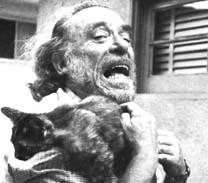
in grievous deity my cat
walks around
he walks around and around
with
electric tail and
push-button
eyes

he is
alive and
plush and
final as a plum tree

neither of us understands
cathedrals or
the man outside
watering his
lawn

if I were all the man
that he is
cat -
if there were man
like this
the world could
begin

he leaps up on the couch
and walks through
porticoes of my
admiration
Charles Bukowski, 1920-1994
15 September 2005
Courage
Courage is not just the ability to face fear when it crops up but the willingness to create it.
In a way you do this each time you start to practice: what makes a student reluctant to practice is the fear of the shift in awareness the practice brings about. It is important that familiarity with practice doesn't just mean that you slip into a well-trodden Tai Chi groove. Each practice session should vibrate with the danger of the unknown at some point, and each should raise the hackles. Maybe not life-threatening but certainly life-changing (so threatening enough). Always be suspicious and never be content. It always irritates me when a student says they're trying their best: as if they have any idea what their best is. There is always a beyond. Having said that, little by little.
The courage required is the courage to be a different person, or to be more fully yourself. This is probably what listening is.
In a way you do this each time you start to practice: what makes a student reluctant to practice is the fear of the shift in awareness the practice brings about. It is important that familiarity with practice doesn't just mean that you slip into a well-trodden Tai Chi groove. Each practice session should vibrate with the danger of the unknown at some point, and each should raise the hackles. Maybe not life-threatening but certainly life-changing (so threatening enough). Always be suspicious and never be content. It always irritates me when a student says they're trying their best: as if they have any idea what their best is. There is always a beyond. Having said that, little by little.
The courage required is the courage to be a different person, or to be more fully yourself. This is probably what listening is.