I read recently that some of the most interesting poetry being published today in English is written by poets for whom English is not their first language. The use of words and rhythms (as well as the mindset) of such poets are often strikingly and refreshingly different. I remembered this after reading Corinna's comments to yesterdays post where she used the word "pasture" for "posture". Perhaps this is a more appropropriate word even, especially if one considers dwelling in a pasture/posture - grazing in it and becoming nourished by it. John has never recommended standing static in pastures, especially not a double-weighted one such as Riding Horse, because they work against a light lively mind. Far better to do the Form. If you do stand though it is possible to relax sufficiently to find the motion within the stillness. A posture should only ever be still because a light equilibrium has been established rather than a forced rigidity. The difficulty is to separate out and give some life and independence to the various equilibrated energies. This can be encouraged if you allow a subtle and gentle figure of eight into the sacrum - barely enough motion to be noticed. As the energies begin to shake loose of each other you can feel how the figure of eight encourages them to interact and breathe (almost like they are pushing-hands with each other). Liveliness is just a measure of the frequency of these interactions - the breathing becomes a vibration increasing in pitch. In a sense, your usefulness is your ability to embody all frequencies, from the lowest throb where a single pulse is a lifetime, to the highest fizzing tingle.
14 October 2005
13 October 2005
Posture & Energy
I remember once, about 7 years ago, John said to me, “Take up Push posture and I’ll show you what Dr Chi showed me.” I obeyed, and adopted Brush Left Knee and Push, making every effort to get my bum in since I guessed what I was about to be shown may have something to do with this. John then put his hand on my lower back and drove it down and forwards with such energy that my front leg nearly gave way. His touch was very light and not forceful in the slightest and I’m not sure how he achieved such an effect on me – my guess is that he just placed his hand and adopted the posture he required from me himself. I was really shocked as to just how extreme the posture was. It felt as though the front leg disappeared and my connexion with the front heel was purely through the spine, sacrum and coccyx. It also felt as though, as he drove me down, the ground rushed up into me until it was level with the crown of my head. At the time I knew it would be years before I had the strength to even go there again, let alone take that posture as my regular one. However, the feeling has been a standard ever since – something solid and real that I have been semi-consciously working towards. I mention it because we’re beginning to retrieve it in the work we’re doing now and I’ve begun to realise that the strength I required was a spiritual sobriety – an inner quietness – rather than muscular strength. The pain and alarm I originally experienced from the posture was my response to the openness and the energetic invasion of my body by the ground brought about by the adjustment and the relaxation my teacher’s touch and presence induced in me. At this level relaxation means to slip out of the physical world and into the energy one. In the energy world there are always contrary tropisms, hence the figure of eight (and simplistically the circle). Relaxing into correct posture and allowing gravity to bear down induces the contrary rush up of energy into the body and out of the heart, face and crown (the face really glows). This rush can be so strong it can take the breath away and can even cause you momentarily to leave the ground. What is striking me more and more though is that when you relax and slip into the world of energy and heart you encourage those aspects of your environment not already so placed to do the same, especially those entities to which/whom you are connected (heart-to-heart). This is why simply having the company of the teacher is often teaching enough. And of course the more you relax into this world the more you connect because in this world there is no real disconnexion. As a human being you cannot expect to do more good than this. In equal measure, anything less would be an irresponsibility.
12 October 2005
Practice
Purging the computer I found this:
It is the job of the teacher to lend some of her energy and experience to the student so that they can achieve, whilst in her company, spiritual states they can't quite achieve on their own. This will bring to the student strange feelings - whether elation, anxiety, bliss or dread - it is of no importance. What is important is that the student honour this assistance by trying their utmost to remember, retrieve, practice and relive the experience. This is the painful process. How does it happen? Dr Chi could only say, "Somehow." John, as you may expect, says a little more - with Faith, Courage and Sincerity. But without this work the teaching will come to nothing and the teacher will quickly lose interest. When the student is with the teacher the work the student has done glows out of her and inspires more teaching to express itself. In a class situation, when many students are present, it is only those students who so glow that the teacher sees and her teaching is directed at them. The students who do not glow are lucky to be in the presence of the teaching - they are given another chance so to speak. In a one-to-one situation though it is crucial that the student has done the work otherwise there is no life or truth in the situation for the teacher. The student gives to the teacher by giving to the teaching.
It is the job of the teacher to lend some of her energy and experience to the student so that they can achieve, whilst in her company, spiritual states they can't quite achieve on their own. This will bring to the student strange feelings - whether elation, anxiety, bliss or dread - it is of no importance. What is important is that the student honour this assistance by trying their utmost to remember, retrieve, practice and relive the experience. This is the painful process. How does it happen? Dr Chi could only say, "Somehow." John, as you may expect, says a little more - with Faith, Courage and Sincerity. But without this work the teaching will come to nothing and the teacher will quickly lose interest. When the student is with the teacher the work the student has done glows out of her and inspires more teaching to express itself. In a class situation, when many students are present, it is only those students who so glow that the teacher sees and her teaching is directed at them. The students who do not glow are lucky to be in the presence of the teaching - they are given another chance so to speak. In a one-to-one situation though it is crucial that the student has done the work otherwise there is no life or truth in the situation for the teacher. The student gives to the teacher by giving to the teaching.
10 October 2005
Natural
JK has always said that the single instruction from Dr Chi that most affected him was the word Natural, or Natural way best way. John’s investigation of this has lead to the discovery that the heart is the primary natural function of the human being: touch and connexion and softness all aspects of heart, whereas the thinking mind is the unnatural function, the part that lives in denial (of heart), the part that tends to operate through disconnexion. What always astonishes me about John is just how much he drips with connectedness and heart. He is so much of and in the heartworld that even when he thinks it is still of that world. The average person’s brain is filled with facts and data, information, feelings, memories, experiences, and thinking involves picking and choosing and rearranging into new patterns: interpolation and extrapolation. With John thinking is more like tapping into a vast energy bank, dredging ancient knowledge from some strange place (the primal well) where it has been hidden by other entities similarly connected. I know when he’s doing it because the hair at the back of my neck starts to stand on end: with John thinking is far more energetic (or even physical) than neurological. His energy, which through his work is now naturally connected, feels and his mind simply verbalises rather than thinks.
Meditation and contemplation are usually considered to be times when the individual relaxes, gets in touch with their own energy and begins to understand deeper meanings. It is our contention that until you work on connectedness, heart-to-heart, with others, your energy will generally be disconnected, at least from what really matters which is the heartworld, and will be unnecessarily limited. It is your connexion with the heartworld that enables you to touch others with your words, thoughts and deeds. Your ability to touch and enhearten is what we call your humanity. Without connexion to the heartworld there will always be an emptiness at the pit of your being, and living will generally be far more stressful than it should be, and real relaxation, which is a falling into something other than self, will be an impossibility. The truth of Heartworld is that everything touches. It is one thing to know this intellectually, or be attracted by its sentiment, it is yet another to truly understand it. Until you become a part of this world your efforts to touch will always fall short. Like Adam’s finger that limply and weakly (half-heartedly) reaches out for God’s, not quite bridging the gap.
Meditation and contemplation are usually considered to be times when the individual relaxes, gets in touch with their own energy and begins to understand deeper meanings. It is our contention that until you work on connectedness, heart-to-heart, with others, your energy will generally be disconnected, at least from what really matters which is the heartworld, and will be unnecessarily limited. It is your connexion with the heartworld that enables you to touch others with your words, thoughts and deeds. Your ability to touch and enhearten is what we call your humanity. Without connexion to the heartworld there will always be an emptiness at the pit of your being, and living will generally be far more stressful than it should be, and real relaxation, which is a falling into something other than self, will be an impossibility. The truth of Heartworld is that everything touches. It is one thing to know this intellectually, or be attracted by its sentiment, it is yet another to truly understand it. Until you become a part of this world your efforts to touch will always fall short. Like Adam’s finger that limply and weakly (half-heartedly) reaches out for God’s, not quite bridging the gap.
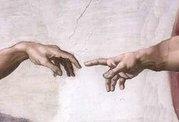
The Truth of Touch
Everything touches.
Touch is everything.
Touch a chord.
Touch-and-go.
Touchingness.
Touch wood/paper/stone.
Touch of nature.
Keep in touch.
Touch is everything.
Touch a chord.
Touch-and-go.
Touchingness.
Touch wood/paper/stone.
Touch of nature.
Keep in touch.
09 October 2005
Openness
An open mind and an open heart are vital for progress. To start with most beginners live in the world of the thinking mind (the normal world) – they are usually reasonably well-educated, reasonably nice, reasonably middle-class and reasonably stiff. They come to their first lesson with some vague idea as to what Tai Chi is but with quite strong ideas as to how the world is and how it behaves, and they have learnt to function reasonably well in it. As my teacher used to say in the first lesson, “You’re all success stories – you’ve got this far – but to go any further you’re going to have to change.” To progress at Tai Chi the students will need to be open to having all their concepts/notions/ideas about anything and everything go through various transformations along the way. This is an exciting process, once one starts, and the Tai Chi class is the ideal environment for change: everyone is well-intentioned and eager to learn and usually there is plenty of support for students finding it difficult for whatever reason. The important change that needs to happen though, the one that was the most difficult for me, is the change in emphasis from head to heart. Until all one’s motivation comes from and to the heart one hasn’t really begun, or rather one is desperately preparing to begin. I always considered myself a good student: I realised in the first lesson that my teacher was the most remarkable person I’d ever met and I was intelligent enough to realise that people like him are very rare and I wouldn’t meet another, not in this lifetime anyway, so I decided to study his art (it’s not Tai Chi but it posed as such originally) to the exclusion of everything else, mainly because that was the approach he recommended. I practised all hours of the day and my life revolved around my daily trips to his Tai Chi school. However, I always had the nagging feeling that I was missing the point: I was going at it the same way I’d gone at everything else in my life – whole-headedly rather than whole-heartedly. The thing about the head is that it thinks the real in – it creates the world the way it would like it to be – it immediately sets up rational barriers between your energy and other energies and there is little energetic communication possible. This was evidenced, in my case, by my inability to respond to energy. I had an open mind in that I loved the excitement of adopting new rational structures and understandings: I would see something I couldn’t understand and immediately and voraciously set about tearing it to shreds to suss it out. However, this was of very limited use when it came to an integrated energetic discipline such as Tai Chi. My teacher’s Tai Chi required me to drop the (open) mind altogether and work from a different place entirely. This is what was difficult. I just couldn’t conceive of a way other than thinking. Eventually the barriers broke, probably from the accumulation of all those hours of hard work, especially the hours one to one with my teacher, and the shift from head to heart started. I always believed it would, as did my teacher, and I guess it’s this belief that saved me.
08 October 2005
Odds & Ends
Talking with JK last night about various things including work, he reminded me of Dr Chi’s obsession with Tai Chi. Apparently he would sleep with the Classics under his pillow so that if he woke up during the night he could dip into the tradition, and he used to work so hard at his Tai Chi that when he got into bed at night he’d have to use his hands to physically lift his legs into bed they’d be so tired and sore. I also remember being told that when practising a slow, sunk Form he’d rarely get further than Crossing Hands because by that point he’d be screaming in agony. Pain does cleanse, and any intensity is better than none.
John also mentioned that students of the Internal will be interested in the meanings behind all things and will be suspicious of the obvious. He also discussed three aspects or qualities: heart, spirit and soul. Put simply, heart is feeling for others, spirit is vitality, and soul is depth. We all have them in varying proportions. The idea is to distinguish which one you’re lacking and concentrate on it. Those with plenty of heart are warm and loving but prone to being taken advantage of. Those with spirit tend to be fiery and great at getting things done (nothing is beyond them), but tend to lack wisdom and can be angry and insensitive. Those with soul are wise, sensitive and slow and prone to melancholia. All can be developed if the student applies themselves intelligently.
I’ve often felt that what my schooling lacked was any emphasis on heart. If, after completing my A-levels at 18 I’d had to spend a year caring for others I’d have turned out a much better person. A term each with children, the elderly and the mentally ill would have been perfect.
Across the road from us here is a home for the mentally ill. We once had a parcel delivered there and I had to go and collect it. I knocked on the door and the face of a young lady with Down's syndrome appeared at the large window next to the door. She opened the window and said, “Hello, my name’s Beautiful Pauline, what’s yours?” I introduced myself and explained why I was there. She ushered me in through the window (she wasn’t allowed to open the door) and led me by the hand to the live-in carer who gave me the parcel at which Beautiful Pauline led me back to the window through which I crawled to exit the building. That girl had so much beauty and heart that I spent the rest of the day in a state of elation, tingling with her energy and goodness, wondering if I’d ever have the courage to trade my intelligence for her heart.
John also mentioned that students of the Internal will be interested in the meanings behind all things and will be suspicious of the obvious. He also discussed three aspects or qualities: heart, spirit and soul. Put simply, heart is feeling for others, spirit is vitality, and soul is depth. We all have them in varying proportions. The idea is to distinguish which one you’re lacking and concentrate on it. Those with plenty of heart are warm and loving but prone to being taken advantage of. Those with spirit tend to be fiery and great at getting things done (nothing is beyond them), but tend to lack wisdom and can be angry and insensitive. Those with soul are wise, sensitive and slow and prone to melancholia. All can be developed if the student applies themselves intelligently.
I’ve often felt that what my schooling lacked was any emphasis on heart. If, after completing my A-levels at 18 I’d had to spend a year caring for others I’d have turned out a much better person. A term each with children, the elderly and the mentally ill would have been perfect.
Across the road from us here is a home for the mentally ill. We once had a parcel delivered there and I had to go and collect it. I knocked on the door and the face of a young lady with Down's syndrome appeared at the large window next to the door. She opened the window and said, “Hello, my name’s Beautiful Pauline, what’s yours?” I introduced myself and explained why I was there. She ushered me in through the window (she wasn’t allowed to open the door) and led me by the hand to the live-in carer who gave me the parcel at which Beautiful Pauline led me back to the window through which I crawled to exit the building. That girl had so much beauty and heart that I spent the rest of the day in a state of elation, tingling with her energy and goodness, wondering if I’d ever have the courage to trade my intelligence for her heart.
07 October 2005
Smiling
The most important thing for a human being is to learn to let their energy out. (Energy will develop and strengthen as part of this process, and not vice versa.) This is what we mean by freedom. Smiling is only useful if it frees up this process. It is a smile of courage rather than a smile of contentment or appeasement. We are not trying to become like the giggling Tibetans or the reactionary New Agers, we are trying to become warriors. Imitate the smile of a warrior about to enter battle. He smiles and laughs to dispel the fear trying to drag him down into the mire of self, to dispel the reluctance to engage (the reluctance to die). A correct smile should instil terror in the heart of the enemy because it is a sure sign that you mean business and are about to explode in their direction with everything you have.
Each moment you find yourself in is pregnant with possibilities - the manifold now. The normal approach is to use the thinking mind to pick or plan a single path through the unfathomable chaos of unfolding reality. We recommend instead you use lightness and humour to cut through the singular linearity of the thinking mind and connect to the totality of this complex. Your engagement can be total - you just have to make a mental leap and realise that reality doesn't happen despite you it happens for you and with you - you are the manifold now.
Each moment you find yourself in is pregnant with possibilities - the manifold now. The normal approach is to use the thinking mind to pick or plan a single path through the unfathomable chaos of unfolding reality. We recommend instead you use lightness and humour to cut through the singular linearity of the thinking mind and connect to the totality of this complex. Your engagement can be total - you just have to make a mental leap and realise that reality doesn't happen despite you it happens for you and with you - you are the manifold now.
06 October 2005
The Tai Chi Centre, South London

Mark Raudva has finally got his website together.
It gives details of his highly recommended Tai Chi classes in South London.
A descriptive list of JK's warm-up exercises, plus other things, can be downloaded from his site.
Stalking
Some disagree with our approach. They claim heartwork interactions are not real and require cooperation. Heartwork requires connexion rather than cooperation; specifically heart to heart connexion. It also requires energy and intensity, honesty and commitment, and a body well enough trained and exercised to respond as a unit and follow the heart - integrity. Those failing to agree with what we do are effectively admitting to living in a world without the magic of connexion – a world of discrete objects involved in scientifically analysable interactions. (I once innocently asked one of the lecturers at university the meaning of life - "Propogation of the species" was his moronic reply.) These people fail to realise that this rational world is the creation of the mind and is just as artificial as the languages we have constructed. These people live in a world devoid of spirit and empty of soul. For us spirit and soul are our bedrock and we acknowledge and intimately work with them every day if not every moment.
Nature is not grammatical. It can be known, not by dispassionate observation but through impassioned joining.
Think a stalking cat.

Photo by Prema
Nature is not grammatical. It can be known, not by dispassionate observation but through impassioned joining.
Think a stalking cat.

Photo by Prema