04 January 2006

Ghost

When talking to myself,
I take a tone I’ve learned

from you – not of boyish charm,
but probing and severe –

to say, some things are clear
and some withdrawn from sight.

A cyclist is only such
while seated on a bike,

a sleeper while asleep.
These forms are only forms

fulfilled, as you are now
no more than this – a tone.

Devin Johnston

Emotions

Emotions and moods can be utilized in the work to train the heart to connect and focus. For example the emotion that accompanies the freeing and opening out of your energy by heart (your own or others) is joy. So, to free your energy simply induce a feeling of joy – be joyful. It's the difference between being a victim of your moods & feelings or the master of them. Think of it as putting on a new costume (the word induce is related to the Latin induere which means to put on clothes). Of course to change the way you feel (are) just like that isn't so easy, especially if for whatever reason you're riddled with worry or anger or doubt (fear). What it requires firstly is the realization that most of what you appear to be is not the real you at all. The real you is the essential sparkle deep down (in the heart) that appears in glints and glimmers regularly but fitfully. When you're working well and correctly this sparkle ignites and informs your energy which flows unimpeded through and into whatever you are doing. Everything else (thoughts, ideas, opinions, habits, assumptions, etc.), which we lump together in the term self, tend to constrain or redirect this process. The self always thinks it knows best. The hegemony of self. It's like a strict parent directing a child – over-riding the child's heart with alien and unnatural impositions. Eventually, the child's heart becomes so plastered over that she loses touch with it and becomes instead her conditioning, or her resentful reaction to it. The job of the teacher is to break through this shell and reconnect the student to their heart. It is the most difficult job on earth, for both the teacher and the student. The problem is that the cultural environment we have created for ourselves is generally of the self and conspires in every way possible (especially through distraction and over-stimulation of the mind and senses) to prevent our heart succeeding in its revolutionary overthrow of its overbearing oppressor, even to the point of convincing the heart that it should naturally take second place to the ego. The outcome of this is that a stupendous effort is required to even begin to burst through. Courage. Cor (heart) and rage. The word gives a clear indication of the intensity and fury with which the student must redirect their energies, and where that energy must come from, if they wish to realize their humanity.

Emotional strength is the attaining of some degree of mastery over them. Not letting them run away with themselves or with you (indulgence), understanding how they layer, transform and oscillate (yin/yang – realizing that they are all in essence the same – just intensity of feeling – and so readily transformable), and putting them to use for you in the work. They are essential because without them you are not operating from heart. The heart feels – deeply. It laughs, it weeps. It can be gentle or fierce. It can love and it can hate. But above all it is vulnerable. It is very easy to knock and hurt an open heart. In a way you could say that this is the problem with the human race – that so much seeming success is attendant upon a closed, hard and even empty heart. The only healthy way around this is to train as a warrior – to always head into the fray with no possibility of retreat. When forwards is natural to you then your heart is safe and you will eventually accumulate enough energy and power to slip through heart to deeper realms. The training begins with encouraging heart, which is naturally unselfish and connective, to leap into the activity. To do things with heart. Forgetting self. For this joy is essential.

03 January 2006

Remember the tortures of learning Tai Chi? I also recall my teacher telling me that the real torture starts after you've learnt it. How to make it meaningful? Work with others as often as possible and let the partner work and the solo work bounce off each other.

02 January 2006

Slake at nature's breeding edge.
John Kells

01 January 2006

Touch

Every particle of you should ache to touch and be touched.
John Kells

There's real teaching in that sentence. A liquid touch. Imagine every cell in you is reaching out to touch whatever it is you're connecting to. Touch is the key to becoming softer. Without it you'll have sensitivity but not the experience that is and becomes softness.

31 December 2005

Influences

Smoke gets into everything:
bitter honey,

autumn's distillation, bears
an aftertaste

of cats
and muscatel.

When privet
dominates, hives

disperse in sparks
through private darkness,

filling cells
with evidence of elsewhere:

spores of cockle,
rush, and dock;

contraband,
perfume, and punk.

Even you (asleep
and breathing deeply)

open from the core
to all that you are not.

Devin Johnston

Devin, as well as being a fine poet, also runs a fine publishing house called Flood Editions. Their latest release is a new translation of the Tao Te Ching.

Honour

I've been listening to poetry on the Internet lately, read by the poets themselves. Robert Creeley reads from the Introduction to his Selected Poems:

It was Ezra Pound who first impressed me with his emphasis, “Only emotion endures.” Just a few nights ago I heard a friend from college days, talking about artificial intelligence, his authority. He noted the banality, in some respects, of emotions, that is, how, neurologically, they are a familiar spectrum and shift almost crudely from one to another – whereas the intellectual acts which are so sponsored, what we think thus funded, are of extreme human interest and consequence. Again Williams: “The poet thinks with his poem, in that lies his thought, and that in itself is the profundity.” No doubt it is all a dream, humanly speaking, but how language thinks to say it, what it thus makes of its own mind and feeling, is to me ever provocative. “A new world is only a new mind, and the poem and the mind are all apiece.”

To write a poem there needs to be a general movement from the poet's deepest recesses where they are naturally connected to all, through their energy, feelings, emotions, mind, thoughts, words and into the written poem. At the deepest level there is only commonality – a moist togetherness – and with each rising level there is a retraction and a focusing in on the activity and the activator until finally we have the unique product – the poem. Creeley is suggesting that each rising level is more interesting and of more “consequence” than the preceding one. In a sense this is true but only because each rising level has more observable detail and texture – is more specific and more of the realm of language – more describable. In fact it seems pretty obvious that the direction we need to be going, as individual, race and species, is deeper. You can have immensely detailed and involved conversations with work colleagues about the work you have in common, but the unspoken communication you have with your loved one is far deeper and more of your humanity. The reason my teacher feels more connected to his cat than with any other living being is because it's the creature with whom he can communicate on the deepest levels. Whether each is consciously aware of these levels I don't know, but each is honourable enough to live a life which puts these levels first, and so each is moving gradually deeper with and through the other. This is the key really. In a sense it is a matter of relaxation – relax the body, quieten the mind, ignore your feelings, slip through your energy and reside and dwell in those deepest recesses where there is no distinction or separation. However, relaxation is just the technique and needs to come from the right place otherwise it wont be successful – it wont necessarily open you out and reconnect you. That place is the place of honour – of putting something far beyond yourself first and foremost. Sacrifice. The image of the man bidding his young family goodbye to lay down his life in battle for his country (“I could not love thee, dear, so much, / Loved I not honour more”). There is always something beyond, and to get there the heart must in some sense already be there. If this is the case then the general thrust of your life and energy will be to go deeper. Every so often this will engender creative acts which will express themselves as insights – sparks of understanding from those deep levels expressing themselves in the light of day. If you have the intelligence and heart to work with these insights – incorporate them into your practice – then eventually they will help you breakthrough whatever is holding you back from the next (deeper) level. This is the way of it. Each insight is like a stepping-stone across a vast river. If you don't work correctly the next wont appear, and if you don't work hard enough you wont be able to leap to it. A teaching is just the first few stones given to you for free. It is always possible to fail. This is the fear that keeps you working.
30 December 2005

                   MATTENS

I cannot ope mine eyes
But thou art ready there to catch
My morning-soul and sacrifice:
Then we must needs for that day make a match.

My God, what is a heart?
Silver, or gold, or precious stone,
Or starre, or rainbow, or a part
Of all these things, or all of them in one?

My God, what is a heart,
That thou shouldst it so eye and wooe,
Powring upon it all thy art,
As if that thou hadst nothing els to do?

Indeed mans whole estate
Amounts (and richly) to serve thee:
He did not heav'n and earth create,
Yet studies them, not him by whom they be.

Teach me thy love to know;
That this new light, which now I see,
May both the work and workman show:
Then by a sunne-beam I will climbe to thee.

George Herbert

Natural

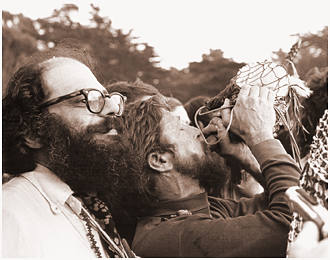
I told my teacher the famous story about Allen Ginsberg and Gary Snyder's visit to the Dalai Lama in India in the 60's. Much to Snyder's embarrassment Ginsberg started telling his Holiness about his drug experiences. The Dalai Lama listened and then commented that the experiences sounded like the sort of states experienced adepts get into during deep meditation, but added that what is important is to be able to get into those states with an act of will rather than by ingesting artificial and harmful substances. My teacher listened to this story and commented that in fact if one leads and has led the correct sort of life and has done the work required then these states will happen naturally and will will not come into it. “Natural way best way,” was one of Dr Chi's sayings. Any force or intent to gain quick results implies incorrect motivation. One does the work for the work's sake not for one's own.

Okinawan Proverbs

One who eats plain food is healthy.

The heart is the most essential human quality.

Even if you hide yourself from the world, don't lose sight of your real nature.

The first isn't immediately obvious but is very important. Kidney hygiene is an essential part of my teacher's teaching. This means no rich food, no animal fat, and plenty of fresh fruit and vegetables, particularly brassicas, and plenty of good water. Fasting for more than a day is not recommended.

We are united;
we make each other pregnant.
Rachel Blau DuPlessis

29 December 2005

The Warrior Heart

The more time I spend with my teacher the more I realize that the strength he has developed through his work, which is considerable, is simply the strength to let go and become the connexions that inform and define him. In fact holding on isn't an option for him nowadays, and being a passionate Irishman I'm not sure it ever was. If ever there was a man ruled and directed by the heart it is he. What this means for his energy is that it is always out there interacting and interfering – involving. Nothing is held back. One of the tenets of his teaching is that if something is interesting and seems to work then do it all the time. This is why the energy he would use to strike a deadly blow is exactly the same energy he would use to heal another or even to stroke his beloved cats. As far as he is concerned there is only one thing – the connexion – and what passes along that connexion depends totally on heart. It's the difference between using heart and spirit to direct the energy. Spirit is the vital spark within – the Chinese call it spirit of vitality – which unifies and coordinates your faculties and allows you to operate effectively, potently and satisfyingly. However, it is still a tool of the self, and having a good strong spirit does not imply that you are any more egoless than the average person. The martial arts world is littered with masters with terrific and terrifying spirit. Their spirits have given them a reactive sensitivity which regards the other with respect but without compassion – without passion. The respectful distance. Consequently their martial spirit is not something they can really bring into the family home or practice at all times – there are many (most) situations in which it is inappropriate. Heart is about being open and vulnerable enough to broach and bridge the respectful distance – in fact not allowing it to develop in the first place. Having so much feeling for the other that they were never apart from you. This is something that can absolutely be practised everywhere, especially with family – your nearest and dearest. And like everything, the more you practice the better you get – the more refined and subtle become your interactions and the more you begin to become aware of those deeper levels which are all heart and which, given a chance, will work all the time for you. Satisfaction – which implies a withdrawal into self after the experience is over – doesn't really come into it. Partly because the experience is open ended – is never over – and partly because withdrawal is not an option. Rather like an Emily Dickinson poem which ends with an unresolved non-rhyme and a dash (—), leaving the heart even more open and aching than it was at the beginning.

The heart gushes. When it's working well it feels like it's more with the other than it is with you. It doesn't let up. There is no distance. Last time I was in Ireland I was introduced to someone who had cancer. Surprisingly (for me) I saw his illness as a black cloud hanging over him and I was fascinated by what I saw and felt. It was only after he left that I realized what my teacher would have done in such a situation. Being the consummate warrior he would have instantly engaged the blackness in battle – he would have leapt in, engaged the person in hearty and uplifting conversation and banished the blackness from his presence. For him healing has nothing to do with wanting to help people, or with doing good, but simply with not being able to tolerate any negativity in his presence because he knows that given half a chance it'll start to attack him and he knows from experience that the only way to deal with the enemy is to strike first. Certainly not to stand by and observe. The heart is overwhelmingly active, so much so that it cannot be resisted, by you least of all.

28 December 2005

Christmas

Back home after the journey from hell yesterday. 11 hours to travel just over 200 miles. At one point the train in front “froze” to the tracks (it didn't feel that cold to me). “Due to adverse weather conditions . . .” started the announcement at which the old codger in front of me quipped, “Oh, an unexpected winter.”

Took the kids to see King Kong on Boxing Day and it was interesting to see their responses. My son was wowed by the special effects (which were relentless and eventually tedious) and the gruesome killings and munchings, whereas my daughter was totally affected by the romance – the movie is a love story – and the poignancy. My son said afterwards, “It was too long. If it was an hour shorter it would have been a better movie,” which is true enough. When I asked my daughter what she thought of it she just nodded her head, tears still streaming down her face. She was still immersed and her critical faculties hadn't kicked in. Hopefully they never will.

My son & daughter are like chalk & cheese, evidenced particularly when I try to photograph them. As soon as my daughter sees the camera she starts to beam and let her energy out and consequently it's impossible to take a bad picture of her, whereas my son pulls his energy back in in a desperate attempt to create the right image for the camera and in the process he ruins not only the photograph but also the situation.

On Christmas Day I helped each of them make their own little movie. I first gave my daughter the camera, and then my son, and told them to go around the house and shoot about 4 or 5 minutes of short clips which we would then edit together on the computer. My daughter just shot the things she liked – the cat, her hamster, her mother, etc – which we edited together in the order in which they were shot, with no trimming, added a soundtrack and had us a wonderful 4 minute short. My son took into consideration (worried about) plot, continuity, development, pacing etc, agonized over the soundtrack, and produced an equally wonderful but very different movie. When we watched the two in succession I was surprised (and delighted) that they both much preferred the other's attempt – they appreciated the qualities that their own lacked. Developing roundness and fullness of character is all about having the heart to see, appreciate and absorb qualities in others that you lack yourself.

26 December 2005

We attend to each other
like birds

and eat

from one another's hands.

Rachel Blau DuPlessis

Heartwork in the dark whilst pointing the camera at the Christmas tree.

25 December 2005

The Waltzing Heart

Reading poetry on the train yesterday, and being drawn into a beautiful energetic space by it (Rachel Blau DuPlessis was the poet), a space so soft and misty I could not, nor was inclined to cling to anything, I realized that objects are largely defined by our attachment to them or our disconnexion from them. I would say that attachment and disconnexion are functions of the mind and are largely fearful (needy), whereas connexion and detachment are functions of the heart and are largely compassionate (loving). When the heart opens, which it can only do really if activated by a wave of giving (love), then the needy clinging habitual mind – the part of you that takes things for what they are because that's the way they were yesterday or that's the way you've been taught that they are – relaxes and detaches. The things in your life thus detached from respond to this by opening up themselves, shrugging off the ill effects of your mean (reducing) mind. So the wave of love that opened the heart induces a similar wave in that part of the world your opening affects. When these two waves meet then we have the second function of the heart which is to join – to connect. Joining is an energetic mingling – a give and take – a conversation – a seepage – and its inevitable action (inter-action) commences the third function of the heart – transformation, or becoming – and changes all of you forever. Each of these actions – opening, joining and becoming – is like a wave of energy, so in fact there are three waves, so close together to appear or be felt as one, but actually three – beginning, middle and end – and the three together give a rounded satisfying completeness to the experience. Like an embrace – the opening being the arms moving apart and the heart leaping out its invitation, the joining being the first contact and the arms encircling, and the becoming being the arms hugging around the other's back and drawing them into your heart as you get drawn into theirs – enclosure. (This is how Ward Off should feel. It should have three distinct actions, felt crudely in the shoulder as back & out, forward and around.) When you involve the heart you effectively dance a waltz – a three-step – all the time.

I remember once attending a workshop in which it was demonstrated convincingly that the heart actually beats in three (BOOM boom boom BOOM boom boom etc) and music that beats similarly strengthens the heart whereas music with an even beat – in two or four – tends to make you want to march – is militaristic – and actually damages the heart by over-riding it. There's also an essay by Bob Brotzman kicking around on the Internet in which he argues that much of the appeal of early jazz and blues, and also I suspect much band music such as Sousa, is in the tension (torque) between the even beat and the swing (giving more weight to the first of each pair of eighth notes – effectively triplets the first two notes of which are tied). Broadly a march but internally a waltz. Skipping? Remember that beautiful scene in the The Tin Drum in which Oskar subverts and deranges the marching band at the Nazi rally by playing waltz rhythms on his drum under the band podium. The band members find his rhythms impossible to resist and gradually join in, causing the stern rally members to drop their rigid salutes and take partners and dance. Transformation.

Oh and by the way, Merry Christmas.
Try and do a little Tai Chi today even if it's only 5 minutes in the secrecy of the bathroom (away from closed minds). It's important.

24 December 2005

Grace

Slip from heart to sacred soul.
John Kells

As the spirit intensifies and strengthens so it relaxes and takes the energy into all areas. In much the same way that an excess of physical strength is required before the body can be put to use loosely & fluidly. The residual needs to be worked as well. In a way we are just eradicating dead space - coming to some understanding of totality, because there needs to be an intense togetherness before those leaps into the unknown can even be attempted. How do you lift yourself by your own boot-laces? Not only must the mind stop resisting the teaching but the energy must join forces with it so that you start creating your own grace. Heart & soul.

Seep beneath as ally to the onslaught.
John Kells

23 December 2005

Attacking

The reason partner work in Tai Chi is far more important than solo work is because the difficulty for most people is not developing energy but letting it out communicatively. Communication requires a connective passage – a conduit – to be established, and then for energy to be passed back and forth through that conduit. In a way the difficult part of the process is the beginning bit – creating the conduit – making the connexion. It is this that requires heart and the qualities that accompany and define heart such as openness, generosity and courage. To maintain a connexion and a communication requires stamina, patience, loyalty, concentration, and the ability to actively listen – to give energy with your listening so that the other person feels good about their giving. To finish and end a communication requires an incisive and decisive ruthlessness – the ability to be connected without being attached, and hence the ability to disconnect when the time is right in such a way that neither of you are left bleeding energy into a void that was the other. Heart is involved and required in each stage, beginning, middle and end, because it is the heart that governs connexion, even its correct severance.

The problem with pushing hands is its continuous nature – the fact that it tends to be all middle. It is important to practice the applications as well so that each of you has experience at making that initial bite into the other persons energy and spirit, and also the final deadly blow which shakes and explodes your energy into their visceral cavity. The postures gather energy during the yielding phase and then direct that energy during the attacking phase. Without a powerful attack the preceding yield lacks meaning and incentive. And without ensuring each of your postures, either in your solo practice or in the partner work, ends to some degree explosively and brutally (if only in the mind) then you wont develop power and your spirit wont be gradually shaking free from the shackles of mind and body.

Try practising an explosive Form every now and then. To do this stamp the foot down hard on the final attacking step of each posture and let the waist shudder into both leg and the attacking arm. Let out a sharp sound from the mouth at the same time – we often use Pah! with an explosive p, but any short shout will do (if you feel inclined to scream then you're probably overdoing it). The stamping foot shakes up and loosens your body energy, making more of it available for your attacks. If nothing else this approach is invigorating and nicely cuts through the deadly grind of Tai Chi.