The hillsJoseph Massey
aligned
with clouds
aligned
with the
windowsill
levitate.
05 March 2006

We drove into Kerry ostensibly to view a venue at Inch for a 5 day residential Heartwork retreat I'm planning to run in September. If anyone is interested then get in touch (email at top of page). It should be appropriate for beginners as well as old Tai Chi hands.
This is the smallest of the Blaskets.
This is the smallest of the Blaskets.
04 March 2006

The Great Blasket (Blascaod Mór) - An Fear Marbh (The Dead Man) - taken looking West into the Atlantic from Dunquin (Dún Chaoin) on the Dingle (An Daingean) peninsula. Inhabited until 1953, the island, 2 miles off the coast, apparently produced more poets and storytellers than any comparable area in Ireland.

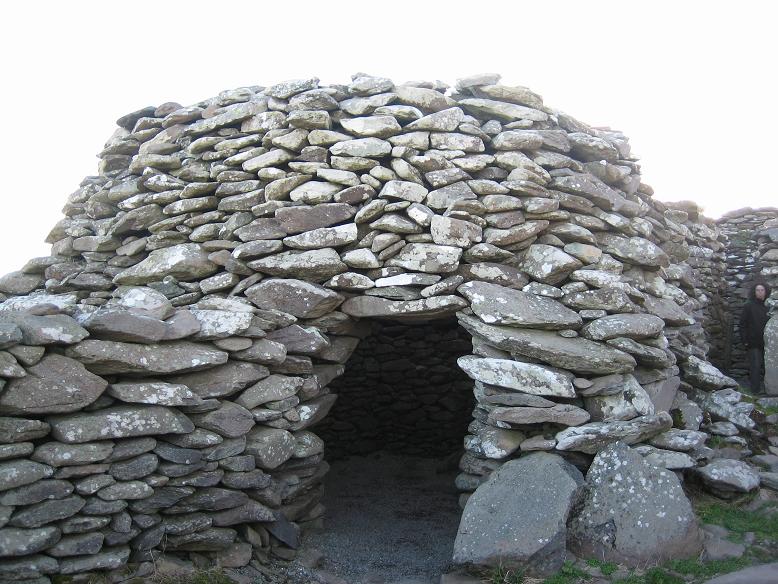
Prehistoric beehive hut near Slea Head, Dingle peninsula, County Kerry, Ireland. Slea Head is the most Westerly point of Europe.
"Ringforts are the most numerous and widespread field monuments in Ireland. These sites were commonly referred to by the terms Fort, ráth, lios, cathair or caiseal, the individual site names often incorporating one or other of these terms. Ráth and lios usually apply to earthen banked ringforts and cathair and caiseal to stones cashels.
The majority of these were enclosed farmsteads of the free farmers of the Early Christian Period, the banks and fosses acting as a fence to prevent livestock from straying and to protect against cattle raiders and wild animals. The small size of the sites suggests they were occupied by a single family, the houses, farm buildings and storage places occurring within the enclosed space. They would have been inhabited from ancient times to 1200AD.
These huts were often found attached to each other with a doorway leading from one to the other. These houses were generally made of stone because stone was plentiful. They were generally round like a beehive and a special type of craftsmanship is apparent in the building. They were erected in the form of a circle of successive strata of stone, each stratum lying a little closer to the centre than the one beneath and so on upwards until only a small aperture is left at the top which can be closed with a single flagstone or capstone. No mortar was used in building. The stones have a downward and outward tilt so as to shed the water. This method of building is called corbelling.
This Cashel is called Cathair na gConchúireach (Caher Conor). It is now occupied by five structures, one souterrain is visible and one of the structural stones in the cashel wall bears an inscribed cross."
"Ringforts are the most numerous and widespread field monuments in Ireland. These sites were commonly referred to by the terms Fort, ráth, lios, cathair or caiseal, the individual site names often incorporating one or other of these terms. Ráth and lios usually apply to earthen banked ringforts and cathair and caiseal to stones cashels.
The majority of these were enclosed farmsteads of the free farmers of the Early Christian Period, the banks and fosses acting as a fence to prevent livestock from straying and to protect against cattle raiders and wild animals. The small size of the sites suggests they were occupied by a single family, the houses, farm buildings and storage places occurring within the enclosed space. They would have been inhabited from ancient times to 1200AD.
These huts were often found attached to each other with a doorway leading from one to the other. These houses were generally made of stone because stone was plentiful. They were generally round like a beehive and a special type of craftsmanship is apparent in the building. They were erected in the form of a circle of successive strata of stone, each stratum lying a little closer to the centre than the one beneath and so on upwards until only a small aperture is left at the top which can be closed with a single flagstone or capstone. No mortar was used in building. The stones have a downward and outward tilt so as to shed the water. This method of building is called corbelling.
This Cashel is called Cathair na gConchúireach (Caher Conor). It is now occupied by five structures, one souterrain is visible and one of the structural stones in the cashel wall bears an inscribed cross."
03 March 2006
Practice
They say "practice makes perfect." Of course, it doesn't. For the vast majority it merely consolidates imperfection.
Henry Longhurst
Henry Longhurst
This is why it is imperative to receive regular instruction, and to listen to that instruction. If you are honest with yourself then you can find little instructions everywhere. However, for the big ones you need someone you trust to wake you up and point the way, otherwise there is always the tendency to practice what you know rather than what you need to know.
02 March 2006
01 March 2006
Survival
Someone threw one of my rhetorical questions back at me:
WARRIORSHIP : Really it is simply a matter of taking yourself in hand, and living a simple true life that gradually makes you stronger and better connected (can't have one without the other). And learning that the truth has a bitter taste, not a sweet one. Facing up to things is difficult and grim (will definitely require SACRIFICE) but will ultimately empower.
Most of what you feel - of what comes in - is rubbish - figments of an overactive ego. Imagine a heavy barbell on your shoulders and having to squat with it. The pain and discomfort will be intense and there will be so much telling you to quit but if you manage to connect to the truth of the endeavour - the heart of the exercise - that fine subtle line of posture and attitude then you will succeed. This is what we mean by connectedness. It has nothing to do with being nice or sociable with worthless idiots and everything to do with feeling, finding and living the truth.
Become interested in ESSENCE and comsumed by a fascination for TRUTH.
And most importantly of all, find and follow GREAT TEACHING.
"How do you survive the onslaught of energy impinging and impressing on you all the time?" Can you say more about this? In the absence of a survival strategy - surely that way madness lies?ENGAGE IT : Everything I say addresses this problem. There are no easy answers other than to start the work and then continue, and to have the intelligence and grace not to die before you've finished.
WARRIORSHIP : Really it is simply a matter of taking yourself in hand, and living a simple true life that gradually makes you stronger and better connected (can't have one without the other). And learning that the truth has a bitter taste, not a sweet one. Facing up to things is difficult and grim (will definitely require SACRIFICE) but will ultimately empower.
Most of what you feel - of what comes in - is rubbish - figments of an overactive ego. Imagine a heavy barbell on your shoulders and having to squat with it. The pain and discomfort will be intense and there will be so much telling you to quit but if you manage to connect to the truth of the endeavour - the heart of the exercise - that fine subtle line of posture and attitude then you will succeed. This is what we mean by connectedness. It has nothing to do with being nice or sociable with worthless idiots and everything to do with feeling, finding and living the truth.
Become interested in ESSENCE and comsumed by a fascination for TRUTH.
And most importantly of all, find and follow GREAT TEACHING.
28 February 2006

Tullius Maximus.
This seal point Birman is Gerrilyn's cat. John reminded me that Wal (Ian Waller) used to breed Birmans.
Be different
My teacher used to say this to me all the time.
In fact this is the constant message from your teacher.
The good student accepts the challenge willingly and whole-heartedly and is instantly different, delighted and daunted by the immediate improvement. Delighted because he feels the truth of this new way and daunted because he knows life is going to be tougher, at least until he becomes accustomed to the changes.
The mediocre student changes to some degree when the teacher challenges them, but then reverts when the inspiration wears off. This is because they don't practice either correctly or enough to generate their own inspiration, and because they don't believe in either the teaching or, on a deep level, themselves.
The poor student isn't prepared to be different at all. You'd think that they would very quickly stop coming along, but they are often clever and know a good thing when they see it and are able to deceive sufficiently to be allowed to ride the energy of the class without actually giving anything real in return, especially not any commitment to change, which is the only real thing you give the teaching, or indeed anything.
This last point is the key to yielding. Real yielding has nothing to do with maintaining balance and equilibrium under pressure. It is all about having the spirit and heart to change when you are required to, which is all the time (each moment). If you are in a situation in which you can successfully maintain balance and equilibrium then it is trivial, unworthy of you and a waste of time. Or, and this is far more likely, you are drastically missing the point. I remember dear old Lester from the Wimpole Street days, well into his 70's having been a commando during the war (he'd actually killed) and a weight-trainer all his life. Someone offered to buy me a set of weights so I asked him what to buy. A barbell, two dumbells and 100lbs of iron was the reply. Will that be enough I asked – I was already squatting over 50kg. More than enough he told me – there are always ways of making it more difficult. Honesty is just so important.
A mediocre student is in a transition stage. They are half way between good and poor and always moving towards one or the other. With a truly mediocre student the teacher is always hopeful that they may chose to move towards goodness and begin to really take on board the teaching. Until they become a good student they haven't actually begun – the transition from mediocre to good is what my teacher calls preparation for the teaching. What is surprising is how many mediocre students chose to drift towards poor. An advanced Tai Chi class will often contain one or two good students and ten or more poor ones, all of whom started as mediocre.
An advanced mediocre student is one who is still able to convince themselves that the teaching is what they would like it to be rather than what it is. If a student is good, mediocre or poor in the Tai Chi class where standards are high and interactions are (hopefully) real then they are the same in any situation. If a poor student finds something they are good at then the chances are they are either kidding themselves (are not receiving accurate feedback) or have found a world with low standards – one that allows (or even encourages) avoidance. In my experience academia is the best example of such a world. I positively shone there so you can imagine the shock I felt on finding my teacher and Tai Chi and quickly realizing what an inept turd I really was (am).
In fact this is the constant message from your teacher.
The good student accepts the challenge willingly and whole-heartedly and is instantly different, delighted and daunted by the immediate improvement. Delighted because he feels the truth of this new way and daunted because he knows life is going to be tougher, at least until he becomes accustomed to the changes.
The mediocre student changes to some degree when the teacher challenges them, but then reverts when the inspiration wears off. This is because they don't practice either correctly or enough to generate their own inspiration, and because they don't believe in either the teaching or, on a deep level, themselves.
The poor student isn't prepared to be different at all. You'd think that they would very quickly stop coming along, but they are often clever and know a good thing when they see it and are able to deceive sufficiently to be allowed to ride the energy of the class without actually giving anything real in return, especially not any commitment to change, which is the only real thing you give the teaching, or indeed anything.
This last point is the key to yielding. Real yielding has nothing to do with maintaining balance and equilibrium under pressure. It is all about having the spirit and heart to change when you are required to, which is all the time (each moment). If you are in a situation in which you can successfully maintain balance and equilibrium then it is trivial, unworthy of you and a waste of time. Or, and this is far more likely, you are drastically missing the point. I remember dear old Lester from the Wimpole Street days, well into his 70's having been a commando during the war (he'd actually killed) and a weight-trainer all his life. Someone offered to buy me a set of weights so I asked him what to buy. A barbell, two dumbells and 100lbs of iron was the reply. Will that be enough I asked – I was already squatting over 50kg. More than enough he told me – there are always ways of making it more difficult. Honesty is just so important.
A mediocre student is in a transition stage. They are half way between good and poor and always moving towards one or the other. With a truly mediocre student the teacher is always hopeful that they may chose to move towards goodness and begin to really take on board the teaching. Until they become a good student they haven't actually begun – the transition from mediocre to good is what my teacher calls preparation for the teaching. What is surprising is how many mediocre students chose to drift towards poor. An advanced Tai Chi class will often contain one or two good students and ten or more poor ones, all of whom started as mediocre.
An advanced mediocre student is one who is still able to convince themselves that the teaching is what they would like it to be rather than what it is. If a student is good, mediocre or poor in the Tai Chi class where standards are high and interactions are (hopefully) real then they are the same in any situation. If a poor student finds something they are good at then the chances are they are either kidding themselves (are not receiving accurate feedback) or have found a world with low standards – one that allows (or even encourages) avoidance. In my experience academia is the best example of such a world. I positively shone there so you can imagine the shock I felt on finding my teacher and Tai Chi and quickly realizing what an inept turd I really was (am).
27 February 2006
Work
Develop a healthy relationship with the principles – a working one.
Your endeavours should stretch, bend, ply and sometimes distort them – the same way they do you.
Wrestle with them rather than blindly or meekly obey them.
Let the work regularly take you into areas where your principles begin to break down and threaten to mutate.
Only then will you condition, extend and enrich both yourself and your relationship with the work.
Your endeavours should stretch, bend, ply and sometimes distort them – the same way they do you.
Wrestle with them rather than blindly or meekly obey them.
Let the work regularly take you into areas where your principles begin to break down and threaten to mutate.
Only then will you condition, extend and enrich both yourself and your relationship with the work.
26 February 2006
The Connective Space
The point I was labouring yesterday was that your solo practice, as well as training the body, mind and energy (spirit) – work that may increase your effectiveness once you have made connexions with other beings – should also facilitate the making of those connexions. My teacher used to have a saying, “If you practice when tired then you practice dullness,” which doesn't mean that you shouldn't practice when tired, but that no matter how you feel you should allow the practice to open out into what we call “the connective space.” This doesn't require any more energy than usual, in fact it requires less because it is always naturally wanting to happen, and what generally prevents it is resistance – we prefer to enter some other space – one more of our own making. The relaxation of Tai Chi is simply cutting out this resistance and allowing yourself to be drawn into this connective space. It is a space full of lightness and gentle humour, and it is above all inspiring – it literally breathes spirit into you. When you are tired you need to rest so you may subconsciously be reluctant to enter this space, knowing that if you do you'll soon get a second wind, become enthused and probably overstretch yourself. However, if you use a little common sense then it should be possible to practice gently and willingly, enter the connective space and have the wisdom not to abuse the energy that space lends you. The wonderful thing about solo work is that no one is watching you – it is your time and you can fill it with whatever – so for the sake of touching connectedness – what my teacher calls the humour of the natural process – you can play with the work. Sometimes when we meet up for a session of partner work and it is clear that both of us are tired and a little unwilling then my teacher will say, “Let's have some fun” and we will approach the session lightly, often starting with something new or outrageous. This will often be enough to make the session a success.
It is the entering of the connective space that makes Tai Chi special. It is what happens when you work together and it should be what happens when you work alone. It is quite easy to achieve, once you know how crucial it is. Are your labours making you better able to make a generous (heartful and soulful) connexion with another human being were they to suddenly enter your space? That is the test. When I started working privately with my teacher I was always shocked that no matter how involved or intense the work became he was always totally willing to answer the telephone if it rang, which it often did. I would always get irritated and annoyed that our flow had been interrupted, but for him it was another thread of connectedness – of potential – entering his space which he willingly took up, and in fact the work we were doing made him more willing rather than less.
It is the entering of the connective space that makes Tai Chi special. It is what happens when you work together and it should be what happens when you work alone. It is quite easy to achieve, once you know how crucial it is. Are your labours making you better able to make a generous (heartful and soulful) connexion with another human being were they to suddenly enter your space? That is the test. When I started working privately with my teacher I was always shocked that no matter how involved or intense the work became he was always totally willing to answer the telephone if it rang, which it often did. I would always get irritated and annoyed that our flow had been interrupted, but for him it was another thread of connectedness – of potential – entering his space which he willingly took up, and in fact the work we were doing made him more willing rather than less.
25 February 2006

Practice
The problem with any communicative art is how to practice alone in such a way that it improves your ability to communicate. The tendency is for practice, especially repetitive practice, to create a slick, efficient product which belies a lack of depth. Classical musicians are renowned for this; in fact any art which requires an unreasonable amount of technical skill will tend to place style above content, and that style will become a barrier preventing real communication. If you find yourself marveling at the artists skill, or settling back to be entertained, or even enjoying the situation then communication is probably limited. Real communication is always difficult, uncomfortable and frightening – it grabs you by the throat – never a pleasant experience – and wrenches you into a connected space where the usual landmarks disappear – it places you on the verge where you are most alive – the one between life and death.
The usual process for an artist (including martial artist), of course, is to practice techniques until they become ingrained and second-nature, so that in performance they can give all their attention to the real task at hand – opening up and touching others with their heart and soul. The problem with this approach is that the only time you're getting any real practice is when you perform. When I was a musician we had a phrase - “gig-fit” which basically meant you were performing often enough to be up and capable for the job. Usually if you were performing at least twice weekly then you could guarantee to put on a good performance; anything less than that and the situation would either threaten to overwhelm or your efforts would not hit the mark – they would only strike a glancing blow.
Our heartwork developed in response to this problem. How to practice the real thing, or how to get heart into everything you do. Firstly we upped the amount of daily partner work and increased its intensity so that it involved real fighting spirit. During these sessions so much energy was generated that unexpected things happened – postures changed, textures deepened and detail found its way naturally into simple exchanges that improved their ability to catch and affect both parties. Each session was a journey into uncharted territory. Our solo practice was a struggle to come to terms with what had happened during the partner work, and to retrieve the form of the exchanges – we basically practised exactly what we had done together (memory permitting). The problem was that it is impossible to recreate the intensity and energy of an exchange when you're on your own, and if you try you get very tired very quickly, so what you end up practising is just a shadow of what transpired during the previous meeting. Our next session of partner work would then consist of a frustrating hour or two of trying to get what we had practised alone to work together. Out of this frustration would come a spark of inspiration which would yet again transform the work and thrust us into a space where it all came alive and the togetherness meant something real. This is how we would move forwards – stutteringly. I always had the nagging feeling that our methodology was not quite correct, partly because experience showed me that if I didn't bother practising and instead slept or went into town then the following session of partner work would always be better. There was something about focusing too intently on what was happening or what had happened that blinkered the vision and stunted enthusiasm. The solo work needed as a major component practice that opened out and embraced as well as intricate and complex detailed work – it needed to move in both directions – inward and outward. We have now developed this component. It is what the slow Tai Chi Forms attempt to be – ways of getting in touch with what underlies things – the common ground. However, without the detail and the intensity the slow stuff glides and slips – it fails to catch. It is important that your Form has, at all points, what JK calls “hooks of affection.”
Sorry this finishes abruptly – I'm off to Liverpool now – I'll finish off later.
The usual process for an artist (including martial artist), of course, is to practice techniques until they become ingrained and second-nature, so that in performance they can give all their attention to the real task at hand – opening up and touching others with their heart and soul. The problem with this approach is that the only time you're getting any real practice is when you perform. When I was a musician we had a phrase - “gig-fit” which basically meant you were performing often enough to be up and capable for the job. Usually if you were performing at least twice weekly then you could guarantee to put on a good performance; anything less than that and the situation would either threaten to overwhelm or your efforts would not hit the mark – they would only strike a glancing blow.
Our heartwork developed in response to this problem. How to practice the real thing, or how to get heart into everything you do. Firstly we upped the amount of daily partner work and increased its intensity so that it involved real fighting spirit. During these sessions so much energy was generated that unexpected things happened – postures changed, textures deepened and detail found its way naturally into simple exchanges that improved their ability to catch and affect both parties. Each session was a journey into uncharted territory. Our solo practice was a struggle to come to terms with what had happened during the partner work, and to retrieve the form of the exchanges – we basically practised exactly what we had done together (memory permitting). The problem was that it is impossible to recreate the intensity and energy of an exchange when you're on your own, and if you try you get very tired very quickly, so what you end up practising is just a shadow of what transpired during the previous meeting. Our next session of partner work would then consist of a frustrating hour or two of trying to get what we had practised alone to work together. Out of this frustration would come a spark of inspiration which would yet again transform the work and thrust us into a space where it all came alive and the togetherness meant something real. This is how we would move forwards – stutteringly. I always had the nagging feeling that our methodology was not quite correct, partly because experience showed me that if I didn't bother practising and instead slept or went into town then the following session of partner work would always be better. There was something about focusing too intently on what was happening or what had happened that blinkered the vision and stunted enthusiasm. The solo work needed as a major component practice that opened out and embraced as well as intricate and complex detailed work – it needed to move in both directions – inward and outward. We have now developed this component. It is what the slow Tai Chi Forms attempt to be – ways of getting in touch with what underlies things – the common ground. However, without the detail and the intensity the slow stuff glides and slips – it fails to catch. It is important that your Form has, at all points, what JK calls “hooks of affection.”
Sorry this finishes abruptly – I'm off to Liverpool now – I'll finish off later.
