whatRobert Grenier
I move so
thickly through into
very furry
10 March 2006

Gerda Geddes (1918-2006)
Mark texted me last Friday that GG had died.
As far as I know she was the first Westerner to teach Tai Chi in UK.
Detail
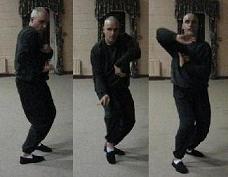
The figure of eight can be thought of as either a circle that has been twisted in which case tightening the curvature to pull towards the centre of the circle (the node or nexus of the eight) requires an increase in energy or intensity, or it can be thought of as a central seed from which expand in turn two embracing loops, in which case a surge or pump of swallowing (open-expand-embrace-close) energy is required each time a loop is generated. In the first case a full-size image already exists of the eight, and the body or mind just traces it out. In the second case the eight exists in tiny embryo form and is “grown” anew each time it is expressed. Both are useful. If the intensity is increased when tracing or generating figures of eight then the eights want to speed up and reduce in size (tighten), but also we find that if the body remains relaxed then those parts of the eight that are generally slack (those parts the body finds easy) tend to flesh out with intricate details. These details are in fact tiny and very fast figures of eight embedded within the path of the main figure of eight. A figure of eight requires two waist turns (left followed by right or vice versa) so an intense figure of eight with much detail will require many waist turns - a vibrating waist.
09 March 2006
Containing duality
The wonderful thing about the figure of eight is its contained dual nature – it is a continuous closed figure containing two loops. We find that there seems to be a law of proliferation in place that naturally generates smaller figures of eight within each of the two loops of a larger eight. These smaller eights can be in any plane. So if you make a figure of eight with the hips or waist then the two arms naturally want to create their own figures of eight which can be thought of as being contained or generated by the eight in the waist. What this implies is that figures of eight always come in pairs – if there's one there must be another somewhere and there must then be a larger one that contains those two, and so on. It is important to have a feeling for this. So when figure of eighting with the waist try to feel the similar eight in the imaginary opponent's waist and try to feel (be aware of) the larger eight containing the two of you (the relationship) (feel this expressing in various planes). As well as you doing figures of eight there is a larger one somewhere doing you. Also be aware that because all this is natural there should quite soon come a point in your work when relaxation and heart (compassion) replace concentrated effort.
08 March 2006
From ECHO
misunderstood as a measure of distance. ItMichael Palmer, from Codes Appearing: Poems 1979-88
takes no time in that sense, repeats nothing,
figures the shape of the flames. Gesticulate.
a failure of translation. In sleep the language
he spoke was one he didn't know. Waking it
sounded the same. Waiting there it seemed a
succession of names, a level field of things in
constant motion, exchanging identities.
neither followed nor following. Two are there as
she counts to one, to one and one then three five
eight defining the spiral, to double sevens to
begin, to instauredness. Left arm and right arm and
the figures like the fire. There must be a
different metric, a gesture and that's all, this
this and so on, concomitance, like writing but
it's not writing, the pieces actually are.
Respect
Try to find and stay with the gentle thread of connexion that runs through your day.AwakenedJospeh Massey
by the ticking
not the alarm.
Once you've caught it often enough you'll never shake it off.
07 March 2006

Borrowing
How do you progress? A big question. Is all Dr Chi could say was “Somehow.” My teacher's advice to me was “Be different.” I remember once him yelling at me to get it right. “But how?” I implored. “That's easy,” he said, “just stop doing it wrong.” High standards indeed and something he is well capable of, always having had terrific spirit. Spirit empowers and makes you altogether capable. But if you're needing to learn something that you don't have within in order to progress then rousing spirit isn't really going to help – it's just going to make you more completely you : Self-yeast of spirit a dull dough sours. This is where the principles of Tai Chi come in. Remember the first lesson where your teacher explains yielding? “You can never guarantee to be stronger than your opponent, but you can always chose to be weaker.” Listening. Putting the other first. Borrowing. To be different you need inspiration from somewhere – you need to borrow energy. Your teacher is constantly trying to lend you some in the vain hope that you may make a little progress. The trouble is that most students abuse the energy – they quickly learn how to channel that good energy into aspects of themselves rather than allowing it to be the instrument and stimulus for change it was intended to be. This really is abuse, and it's dishonest, and extremely ugly to boot. It's not real borrowing because nothing is given in return, apart from the class fees which don't count – they just get you in the door. What you should return is honour and reverence – you should make every effort to assimilate and become the borrowed energy – become more like your teacher. All teachers have experience of good students. You only need one in a class to make that class work. The student is so interested and willing to learn and change that they stimulate the teaching to express itself and as a teacher you quickly find stuff coming out that you didn't even know you knew. This is a natural process – a healthy energy circuit - and unfortunately it tends to happen more readily with beginners than with old hands who feel they've heard it all before and on some level cut off. (If your teacher tells you something again then it's because you haven't heard and accepted the first time, not because they are forgetful or have a limited repertoire.) The important thing here is that the honour and reverence you need to show the teaching and the teacher you must in fact show everything: your life can only effectively contain one message, and you can only effectively be, and be in the process of becoming, one thing. If you manage this then you can borrow energy from everything – nothing is beneath you – you are becoming all the time. This is openness and connectedness. The heart has a front and a back door – you can receive into one and give from the other and become a channel for heart and soul. This is what life should be – a powerful thrust rather than a series of static compartments. There is nothing more exhausting and ageing than having to constantly switch from one mode to another. If people can't take you the way you need to be then leave them behind.
05 March 2006
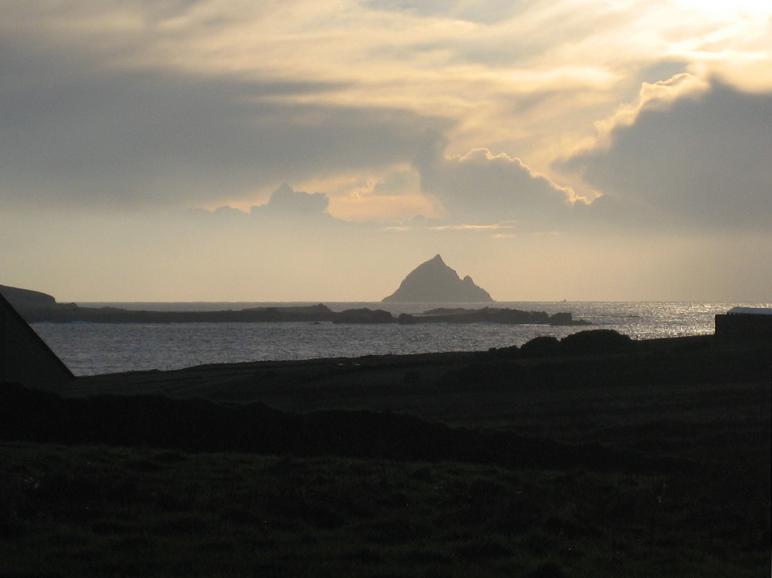
We drove into Kerry ostensibly to view a venue at Inch for a 5 day residential Heartwork retreat I'm planning to run in September. If anyone is interested then get in touch (email at top of page). It should be appropriate for beginners as well as old Tai Chi hands.
This is the smallest of the Blaskets.
This is the smallest of the Blaskets.
04 March 2006

The Great Blasket (Blascaod Mór) - An Fear Marbh (The Dead Man) - taken looking West into the Atlantic from Dunquin (Dún Chaoin) on the Dingle (An Daingean) peninsula. Inhabited until 1953, the island, 2 miles off the coast, apparently produced more poets and storytellers than any comparable area in Ireland.

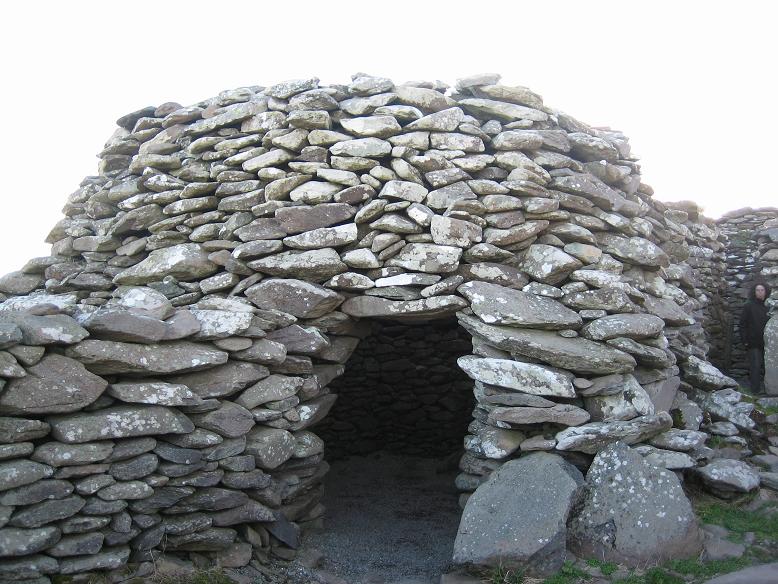
Prehistoric beehive hut near Slea Head, Dingle peninsula, County Kerry, Ireland. Slea Head is the most Westerly point of Europe.
"Ringforts are the most numerous and widespread field monuments in Ireland. These sites were commonly referred to by the terms Fort, ráth, lios, cathair or caiseal, the individual site names often incorporating one or other of these terms. Ráth and lios usually apply to earthen banked ringforts and cathair and caiseal to stones cashels.
The majority of these were enclosed farmsteads of the free farmers of the Early Christian Period, the banks and fosses acting as a fence to prevent livestock from straying and to protect against cattle raiders and wild animals. The small size of the sites suggests they were occupied by a single family, the houses, farm buildings and storage places occurring within the enclosed space. They would have been inhabited from ancient times to 1200AD.
These huts were often found attached to each other with a doorway leading from one to the other. These houses were generally made of stone because stone was plentiful. They were generally round like a beehive and a special type of craftsmanship is apparent in the building. They were erected in the form of a circle of successive strata of stone, each stratum lying a little closer to the centre than the one beneath and so on upwards until only a small aperture is left at the top which can be closed with a single flagstone or capstone. No mortar was used in building. The stones have a downward and outward tilt so as to shed the water. This method of building is called corbelling.
This Cashel is called Cathair na gConchúireach (Caher Conor). It is now occupied by five structures, one souterrain is visible and one of the structural stones in the cashel wall bears an inscribed cross."
"Ringforts are the most numerous and widespread field monuments in Ireland. These sites were commonly referred to by the terms Fort, ráth, lios, cathair or caiseal, the individual site names often incorporating one or other of these terms. Ráth and lios usually apply to earthen banked ringforts and cathair and caiseal to stones cashels.
The majority of these were enclosed farmsteads of the free farmers of the Early Christian Period, the banks and fosses acting as a fence to prevent livestock from straying and to protect against cattle raiders and wild animals. The small size of the sites suggests they were occupied by a single family, the houses, farm buildings and storage places occurring within the enclosed space. They would have been inhabited from ancient times to 1200AD.
These huts were often found attached to each other with a doorway leading from one to the other. These houses were generally made of stone because stone was plentiful. They were generally round like a beehive and a special type of craftsmanship is apparent in the building. They were erected in the form of a circle of successive strata of stone, each stratum lying a little closer to the centre than the one beneath and so on upwards until only a small aperture is left at the top which can be closed with a single flagstone or capstone. No mortar was used in building. The stones have a downward and outward tilt so as to shed the water. This method of building is called corbelling.
This Cashel is called Cathair na gConchúireach (Caher Conor). It is now occupied by five structures, one souterrain is visible and one of the structural stones in the cashel wall bears an inscribed cross."
03 March 2006
Practice
They say "practice makes perfect." Of course, it doesn't. For the vast majority it merely consolidates imperfection.
Henry Longhurst
Henry Longhurst
This is why it is imperative to receive regular instruction, and to listen to that instruction. If you are honest with yourself then you can find little instructions everywhere. However, for the big ones you need someone you trust to wake you up and point the way, otherwise there is always the tendency to practice what you know rather than what you need to know.
02 March 2006
01 March 2006
Survival
Someone threw one of my rhetorical questions back at me:
WARRIORSHIP : Really it is simply a matter of taking yourself in hand, and living a simple true life that gradually makes you stronger and better connected (can't have one without the other). And learning that the truth has a bitter taste, not a sweet one. Facing up to things is difficult and grim (will definitely require SACRIFICE) but will ultimately empower.
Most of what you feel - of what comes in - is rubbish - figments of an overactive ego. Imagine a heavy barbell on your shoulders and having to squat with it. The pain and discomfort will be intense and there will be so much telling you to quit but if you manage to connect to the truth of the endeavour - the heart of the exercise - that fine subtle line of posture and attitude then you will succeed. This is what we mean by connectedness. It has nothing to do with being nice or sociable with worthless idiots and everything to do with feeling, finding and living the truth.
Become interested in ESSENCE and comsumed by a fascination for TRUTH.
And most importantly of all, find and follow GREAT TEACHING.
"How do you survive the onslaught of energy impinging and impressing on you all the time?" Can you say more about this? In the absence of a survival strategy - surely that way madness lies?ENGAGE IT : Everything I say addresses this problem. There are no easy answers other than to start the work and then continue, and to have the intelligence and grace not to die before you've finished.
WARRIORSHIP : Really it is simply a matter of taking yourself in hand, and living a simple true life that gradually makes you stronger and better connected (can't have one without the other). And learning that the truth has a bitter taste, not a sweet one. Facing up to things is difficult and grim (will definitely require SACRIFICE) but will ultimately empower.
Most of what you feel - of what comes in - is rubbish - figments of an overactive ego. Imagine a heavy barbell on your shoulders and having to squat with it. The pain and discomfort will be intense and there will be so much telling you to quit but if you manage to connect to the truth of the endeavour - the heart of the exercise - that fine subtle line of posture and attitude then you will succeed. This is what we mean by connectedness. It has nothing to do with being nice or sociable with worthless idiots and everything to do with feeling, finding and living the truth.
Become interested in ESSENCE and comsumed by a fascination for TRUTH.
And most importantly of all, find and follow GREAT TEACHING.