21 March 2006

Relaxation, talent & sacrifice

We talk about relaxation in Tai Chi & in a way it all comes down to this. Not just relaxing our muscles but relaxing the fearful grip we have the world under, so that it can then begin to open up & reveal itself. The external and the internal world. When the external world opens up many more opportunities present themselves - you become more involved in the rough and tumble of living (this doesn't mean you become more busy - just more involved). When the internal world opens up you begin to feel and work with energy, spirit and heart. When you start working with these then you actually become more talented, or rather your talents can begin to reveal themselves properly. What is striking about people is that they all have something wonderful inside that is bursting to express itself. What prevents it is tension, particularly self-image. Holding on to false images. Idolatry. If people (students) can leave this aside, even for a moment, then they will always have the talent and ability to at least get thoroughly involved in the task at hand without getting tense and anxious. Such total involvement requires you to lose yourself - to stop suffocating with opinions and expectations - so that your energy can do the job. This is wanting to happen - desperately - so to prevent it requires even more desperation - hardness - the real enemy.

Relaxation is letting go. Not just of tension but of everything. Small loss, small gain. Big loss, big gain. If you put the barest minimum in then you'll get the barest minimum out. If you put everything in then you'll get everything out. And in our game anything less than everything will not succeed. Relaxation and sacrifice amount to the same thing.
20 March 2006

Perseverance

The secret is to persevere with the work rather than to persevere with the way you are.
Like the little stream
Making its way
Through the mossy crevices
I too quietly
Turn clear and transparent

Ryokan

19 March 2006

Dance of Vitality

Each loop of the figure of eight should be accompanied by an opening and swallowing in the heart. Really this action of the heart should generate each loop, but to start with we do figures of eight with the arms and waist, and later the hands, feet and eyes, and later still each toe, balls of feet, heels, insteps, ankles, calves, knees, groin, coccyx, sacrum, perineum, hips, belly, kidneys, sternum, heart, scapulae, thymus, clavicles, sternal notch, shoulders, neck, Adam's apple, head, back-brain, mid-brain, fore-brain, temples, eyebrows, ears, nostrils, mouth, chin, jaw, tongue, back of throat, crown, armpits, elbows, forearms, wrists, Tiger's mouths, heels of palms, middle of palms, fingers, tips of fingers, etc. to train the heart to open and get involved. The individual character of each place is felt and dwelt upon. Each involves and requires a slightly different action in the heart, and clearly such practice will develop a richness and depth to the heart as well as awakening these parts of the body and developing an energy component to each. The more parts we can acknowledge and bring into some independent and dependent play – shake loose – the more of the correct sort of energy we will contain – the energy of connectedness – the real dance of vitality.

Reminds me again of my teacher's father who does something similar - but far less selfishly. Before he goes to bed each night he prays. His prayer involves bringing to mind, in turn, each person he has ever known, and re-establishing, in his heart at least, connexion. It takes so long now he has to do half one night and half the next. I don't think he's ever had a casual connexion in his life – one that he has subsequently forgotten. It's all about honouring the connexion and, with all your heart, wishing them well. Many of the Irish are like this – you feel when you meet for the first time that it's permanent – for life.

Practice

The usefulness of practice is that it makes you     move on.

18 March 2006

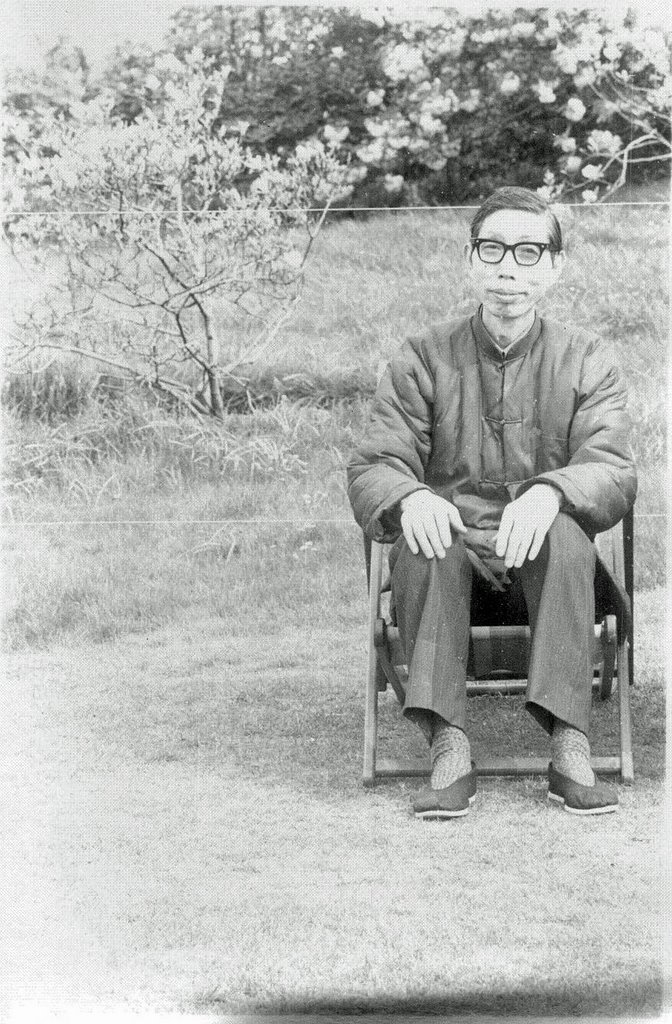
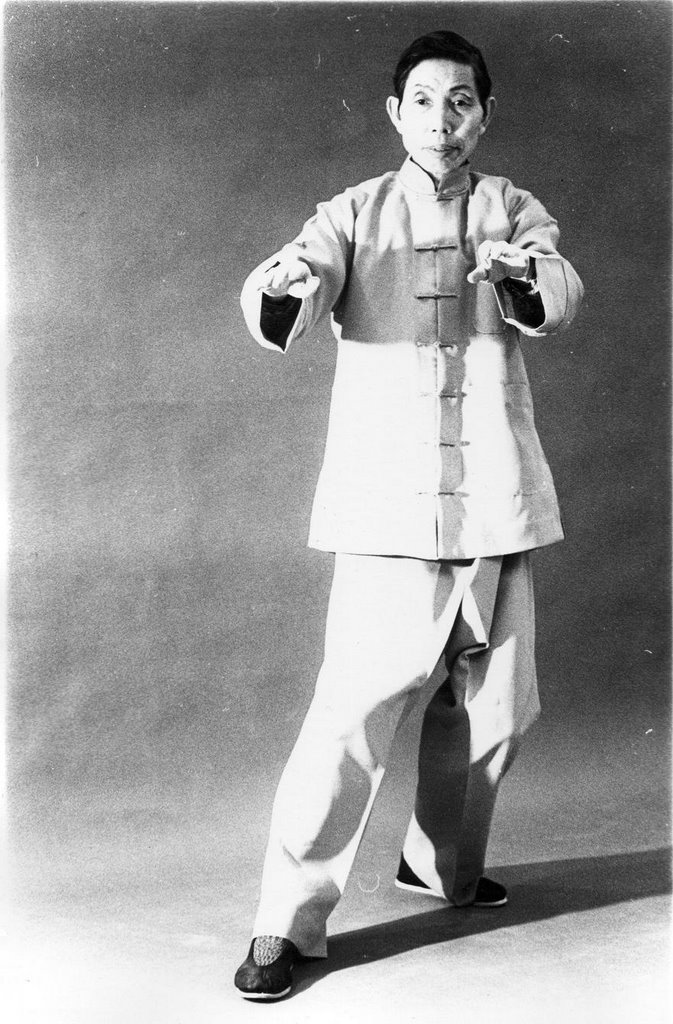
Chi Chiang Tao


Photo by Barbara Richter, 1976.

No one could touch him because he had touched them first - compassion.

Beginner's Mind

Just a whisper of technique. Any more and you become tight and limited. The expertise acquired through practice should be tempered (or countered) with beginner's mind otherwise your practice reduces your possibilities rather than expand them. Beginner's mind is really just an excited innocence – a mind with no expectations – open and willing for anything. As one practices and gets 'better' one gradually slots into a smooth groove along which one flows with ease and grace. This groove is a trap - a slick means to getting closer to another without actually having to open to them. Our culture abounds with such slickness – style & fashion – flash & attractive but empty of heart. A bit like masturbation – dubious momentary pleasure followed by an enduring wretched emptiness (so I'm told). This is why it is important for people of experience to teach – they inspire with their experience and expertise, and the students inspire with their fresh openness: beginner's mind is infectious.

17 March 2006

Love

Email from Corinna this morning:
Did you know that in Danish
Love = Promise ?
I am amazed everytime I come across the word.

16 March 2006


Verne & John, Hugo & Sue, 25 years ago.

Sue Clark is one of my favourite people. If anyone knows her whereabouts can they let me know.

Chi Chiang Tao


All these photos of Dr Chi were taken by Barbara Richter in 1976.

Relaxation & Connexion

When you properly relax, the two halves of the body feel as though they are falling away from each other, loosening their grip and finding their own space & place. Fibres unknit. Tension is a tight congested holding together or holding on – things fearfully cling to whatever is closest. It is only when things relax away from each other that a proper and natural interaction can develop. If things are naturally connected, which all things are, then the relaxed space between is quite alive with the energy of connexion, allowing the spontaneous and continuous creation of the Third Heart – the governing engine of connexion. The nature of an interaction will then depend upon this Third Heart which is allowed to develop and flourish in the nourishing space between, rather than upon the will of either of the interacting entities. This principle of relaxation – the opening up of the space between and the filling of that space with the energy of connexion – should pervade your being. The two halves of the body relax away from each other. Muscle fibres relax away from each other, as do the cells within those fibres and the molecules within those cells. You will then begin to develop a natural energetic presence, and a natural wisdom that stems from your whole physical and energetic being, not from the thinking mind. This is quite apart from ch'i or physical strength or intellectual prowess which require active cultivation – the use of will or mind – and naturally decline with age. If you follow the route of relaxation and connexion then as your faculties inevitably decline you become more and more connected and more and more imbued with, and composed of, the energy of connexion because that is all you have left. I'm thinking in particular of my teacher's father. I visited him just before Christmas to help him with his computer. As I was sitting at the screen he hovered behind me watching and placed his hand on my shoulder with the lightest of touches. Instantly my whole body was charged with his energy which was so fine and alive and pure and unlike anything I had felt before. A frail old man, bent almost double and breathing with difficulty, yet easily the most energetic and remarkable person I think I have met. What is also strange is that when he touched me I suddenly saw the world as though through his eyes – his touch made me him for a moment – and it was a beautiful place – far more so than the world I usually inhabit. His world was the natural and real one – the one of connexion. My world was my own – curled up into itself with brooding dullness. What is interesting is that he has reached such an advanced level by living a life that has constantly and willingly (and happily) put others first.

15 March 2006

Chi Chiang Tao


Photo: Barbara Richter

Perfection.
From Dick Farmer's website.
no time
like the present

there's the road
curving away


I'm suffering

from the
humidity


moonrise

is as red


as someone somewhere


this one

does it now

Robert Grenier

Becoming

Discussing unconditionality with JK yesterday. That what is important is not who you connect with or what you believe in or who you love, but to be a connector, a believer and a lover – to be in the continuous process of connecting, believing and loving. Practising. Regardless. This is how Dr Chi was able to yield to JK before he got out of bed in the morning: yielding mind.

“In any real interchange it is the Third Heart that counts. Fixation on either (or both) of the other two negates potential. It is the same with belief. To be a believer is to be a positive being – a believer is someone who is becoming. Becoming leaves no imprint. There is no mind to deliberate or be backwards. Even a concept of forwards, although useful to combat backwards, is forgotten. Becoming swallows what is commonly known as destiny. Real connexions you make are on your becoming route, and each Third Heart a cog that impels or pulls you along the spiral natural process. This kind of connexion requires this kind of believing and this kind of becoming. Light and embracing, but embracing as a giving from the heart rather than capturing. No matter what any other person might be doing, your becoming brings the Third Heart to its own life, and your positivity is sufficient for its nutrition. And the inspiration of the Third Heart is nutrition for your becoming. The activity is so rich that like or dislike do not come into it, and all one's functions are warmed – irradiated – by its glow.” John Kells

Dance of Vitality

Mark has posted a downloadable video clip of the Dance of Vitality – the pinnacle of Yang Style Tai Chi. JK learnt it from Chu Gin Soon.

14 March 2006

Joe Massey reading. More.
Taught by
the largeness
moving within himself
the truth
which is felt
has only
fixation by
internal means of
transcription.
for Sam

12 March 2006

Destiny

Form and content are, in a way, irrelevant, because what's important is neither what you say nor how you say it but who you are.

11 March 2006

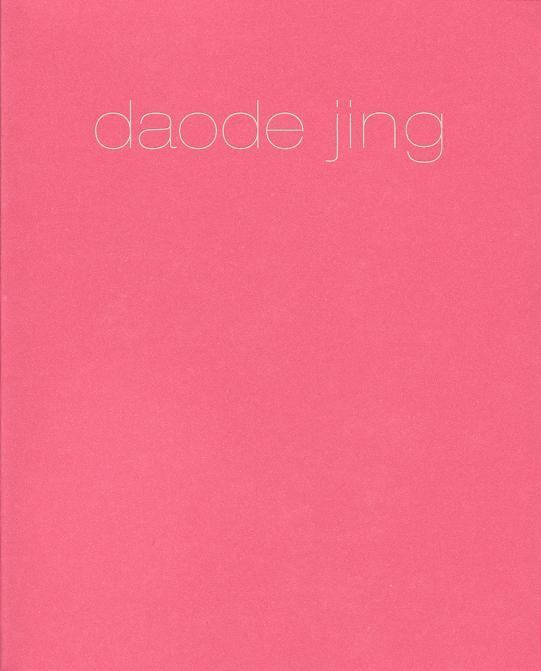
daode jing


Thomas Meyer has a new translation of the daode jing (Tao Te Ching) out.
It is stunning, both as translation & object.
the best direction is barely felt
the next best is like a friend

fear follows after that
dismiss the last as useless

a lack of trust makes
things untrustworthy

quiet and in few words
finish what was begun

so that people say
it simply happened on its own
This website is a useful resource.

Daigu Ryokan (1758-1831)

Found this on the web:

Like Han-shan in China, Ryokan is loved as much for his antics as for his profound poetry.
Ryokan became a priest at age 18 and took to a life of wandering. He eventually met his teacher, Kokusen Roshi, and settled down to study Zen, ultimately becoming his most esteemed student. When Kokusen Roshi died, Ryokan inherited his temple. But the duties and regularity of being temple master didn't suit Ryokan, and he resumed his itinerant life.
He next settled in a small hut he called Gogo-an on Mt. Kugami, where he lived by begging.
Ryokan's love of children and animals are legendary. He often played games with the local children, attested to in his own poetry.
His reputation for gentleness carried sometimes to comical extremes. One tale is told that, one day when Ryokan returned to his hut he discovered a robber who had broken in and was in the process of stealing the impoverished monk's few possessions. In the thief's haste to leave, he left behind a cushion. Ryokan grabbed the cushion and ran after the thief to give it to him. This event prompted Ryokan to compose one of his best known poems:
The thief left it behind:
the moon
at my window.
When Ryokan was 70 and nearing the end of his life, he met a young nun and poet named Teishin. Though Teishin was only 28, they fell in love. They exchanged several beautiful love poems.
As Ryokan was dying, Teishin came to him and held him at his moment of death. It was Teishin who collected and published Ryokan's poetry after his death.


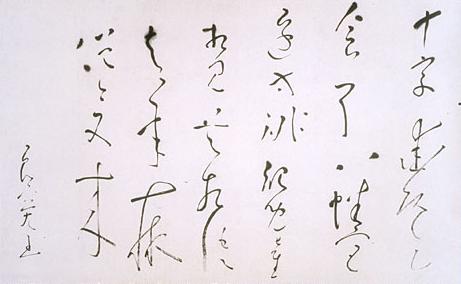
Ryokan's hand.