Hardness implies barriers of self-satisfaction.
Softness implies lack of motives, lack of meanness.
John Kells
11 April 2006
10 April 2006
Truth
The thrust of vitality married to the wisdom of yielding ensures that our limited vehicle has the best chance, the only chance, to join the limitless, boundless, endless truth.
John Kells
John Kells
09 April 2006

Pre-energy
The wonderful thing about between energy, and the big open heart it requires, is its immediacy. When you connect to it and work primarily with and from it then any attempts by the other to manipulate or control, either you, themselves or the situation, are so easily felt and can be cut through literally like a knife through butter. Even obeying the principles of Tai Chi – turning the waist, keeping the lower spine vertical, sinking – if they are having to be concentrated on rather than being allowed to happen naturally, will distract you from the between energy – the immediate reality of that other person in front of you. It is important to have practised the principles sufficiently in your own solo practice for you to be able to forget all about them when working with a partner, and just be with them, working together to get closer to the reality between that's just dying to express itself through your pooled enthusiasm for the magical inspiration of between energy. In fact the term energy is not quite right here because there is something about the reality between that is non-energetic – or at least is pre-energy. The pre stages are the most interesting, and of course the most subtle. When you stand in front of another in a Tai Chi class, when did that exchange actually begin? When you face each other? When the teacher announces “Find a partner” or “Change partners”? The beginning of the class? When you first decided to take up Tai Chi? When you were born? Or before that? Some people you feel you were destined to meet, and some you feel you've known all your life. And even those you don't like or just find difficult, if you work and honour the reality between sufficiently – put their annoying quirks aside and believe that something good can come from the exchange – then sooner or later a deeper connexion will develop, or, more likely, reveal itself to have been there all along.
The most interesting thing, for me, about my last teaching trip to Ireland, was being able to work with complete beginners on the Thursday evening. We started the session with some simple energy circuits which help connect you to the other (or rather open you to the connexion which is already there) and then did the first posture of the Short Form – the one my teacher added. I taught it entirely from the perspective of using the movements to connect heart-to-heart and embrace the imaginary other, and didn't mention the waist, or verticality, or sinking. It was fascinating to watch the beginners doing the posture far better than the old hands (which includes myself I dare say). The old hands couldn't help but relax, turn the waist and sink, and enjoy the power and familiarity of those actions. What they didn't appreciate is that by having those actions primarily in mind and in body they lose the other and remember themselves – the opposite of what we are actually trying to do with the Tai Chi. The beginners, in their innocence, could only do what they were told, which was to step out with their left foot to establish a vertical connexion with the other and then circle their arms to establish a horizontal one. They sank to step, and turned their waist to embrace, and kept their spine vertical (otherwise they'd have lost the directness of the heart-to-heart connexion), but they did it all naturally, not in order to do something else. What was beautiful about it was that even though the beginners were just embracing empty space in front of them, when I watched them from 10 or 15 meters away, I was emotionally affected by their actions. I was drawn into the space they were working with and their heart was moving mine. When I watched the old hands I could make dispassionate judgments about their postures only because they weren't reaching out to draw me in. This teaching experience gave me great hope because it made me realise that solo work needn't be an arena where you just put your body and energy through their paces (training – I despise that term), which, let's face it, is really just working on self. If you work as though the other were really present, heartfully and emotionally (dare I say it), then your work will be benefiting all you are connected with, which, the more you can sink back into the pre stages, becomes gradually the whole of creation. This is natural compassion and natural healing.
The most interesting thing, for me, about my last teaching trip to Ireland, was being able to work with complete beginners on the Thursday evening. We started the session with some simple energy circuits which help connect you to the other (or rather open you to the connexion which is already there) and then did the first posture of the Short Form – the one my teacher added. I taught it entirely from the perspective of using the movements to connect heart-to-heart and embrace the imaginary other, and didn't mention the waist, or verticality, or sinking. It was fascinating to watch the beginners doing the posture far better than the old hands (which includes myself I dare say). The old hands couldn't help but relax, turn the waist and sink, and enjoy the power and familiarity of those actions. What they didn't appreciate is that by having those actions primarily in mind and in body they lose the other and remember themselves – the opposite of what we are actually trying to do with the Tai Chi. The beginners, in their innocence, could only do what they were told, which was to step out with their left foot to establish a vertical connexion with the other and then circle their arms to establish a horizontal one. They sank to step, and turned their waist to embrace, and kept their spine vertical (otherwise they'd have lost the directness of the heart-to-heart connexion), but they did it all naturally, not in order to do something else. What was beautiful about it was that even though the beginners were just embracing empty space in front of them, when I watched them from 10 or 15 meters away, I was emotionally affected by their actions. I was drawn into the space they were working with and their heart was moving mine. When I watched the old hands I could make dispassionate judgments about their postures only because they weren't reaching out to draw me in. This teaching experience gave me great hope because it made me realise that solo work needn't be an arena where you just put your body and energy through their paces (training – I despise that term), which, let's face it, is really just working on self. If you work as though the other were really present, heartfully and emotionally (dare I say it), then your work will be benefiting all you are connected with, which, the more you can sink back into the pre stages, becomes gradually the whole of creation. This is natural compassion and natural healing.
08 April 2006
Hear, her
Clear
Mirror,
Care
His error.
In her
Care
Is clear.
Louis Zukofsky
A Zukofsky Selected Poems has just come out. Edited by Charles Bernstein:
"This poetry leads with sound and you can never go wrong following the sound sense... Zukofsky loved to create patterns, some of which are apparent and some of which operate subliminally... Each word, like a stone dropped in a pond, creates a ripple around it. The intersecting ripples on the surface of the pond are the pattern of the poem."
07 April 2006
btcca
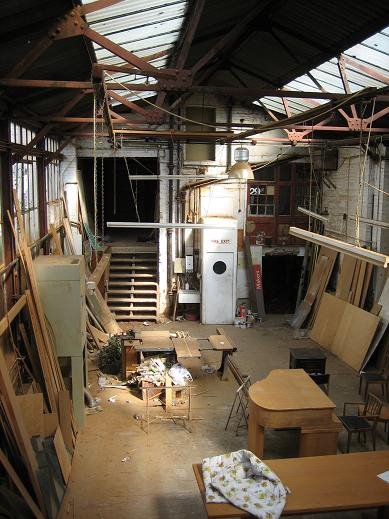
Hopefully there'll be an "after" shot to match & contrast this one in a few weeks time. Then it'll be down to teaching this shit with a vengeance.
those who possess the de's fullness
remind us of the newborn

poisonous insects can't bite
wild animals can't attack

birds can't tear them apart
soft bone and weak muscle

but the grip is firm
no sexual experience

yet fully aroused
entirely made

a complete presence
cries all day

never gets hoarse
everything in its place

to have this balance
is called "constant"

to recognize the "constant"
is having "insight"

a full life is a good thing
when the heart tries to control

what it feels that is called
"forcing things"

when things are forced
they grow old quickly

that is called
"not the dao"

what is "not the dao"
comes to an early end
Section 55 from Thomas Meyer's daode jing
Humility
The beauty of between energy is that it is not really dependent at all on the quanitity of energy or strength either or both parties have at their disposal. It depends purely on the qualities of those parties, and the quality of the interaction. If either party has to muster or rouse their energy then it is too late. The between energy depends upon those qualities you present by the simple fact of your being – by the way you live your life and the principles at it's core and foundation. People who live good lives – who consistently and willingly put others first – who wouldn't even consider an alternative – aren't necessarily good-looking, or intelligent, or strong, or admirable even – all these qualities imply an observational separation – they require you to make that distinction. What they are is humble and in that humility they have an immediacy and an attractiveness – the natural ability to disarm and draw the other into their reality – into the inclusive space of their inherent goodness, for want of a better word. This inclusiveness is the key I suspect. The humble person – the natural yielder – exists in a reality that is larger than that of a less humble person, and can therefore swallow it up with ease. Not just with ease but with compassion: if you can contain another then there will be a natural force in play impelling you to. So humility implies, on one level anyway, big heart. You are so close, so involved, so present that the mind cannot make those cheap distinctions that would cause you, or give you an excuse to retreat into your ivory tower of self-congratulatory wankerdom, as my teacher would call it. The pinnacle of humility is sainthood. For that our model and inspiration will always be Dr Chi.
05 April 2006
daode jing
          to follow the dao means being unfulfilled
          never done never starting all over again
The following is Thomas Meyer's Afterword to his wonderful translation of the daode jing. I quote it for the beauty of the prose as much anything.
Throughout this translation, I cite only four Chinese words (dao, de, lao, and zi). These I preferred to transliterate using the pinyin system which shies away from capital letters. The author of the daode jing (or more commonly in English, Tao-Te Ching) is someone called laozi (or Lao-Tzu). The character lao means “old”. And zi literally means “new born,” but is used to refer in general to a person, any person. So, in English laozi might be “old boy,” “old one,” or “old guy.” But just how dao or de would be rendered is, in many ways, the subject of this book. Throughout the unbroken text, for the sake of orientation and comparison, marginal numerals appear quietly to indicate the beginning of each section.
Although I am no speaker of Mandarin (nor reader, nor writer either), I learned many years ago how to use a Chinese dictionary. So when I found a couple of translations of the daode jing that had the original on facing pages, I decided to take a shot at reading the work first hand. Eventually, a database was set up on my laptop, and everywhere I went I carried it, the text, and a couple of dictionaries with me like a bag of needlepoint. A year or so later, I had myself a rough translation, concordance, and literal mapping of laozi's book. So, for ten years, each spring I have read the daode jing, character by character, one chapter a day, eighty-one days, five thousand characters. All the while, a translation seemed obvious. Though I tried, I didn't press too hard, heeding the old man's advice to look for and follow that inherent, natural course of things themselves. Nonetheless I wondered, how would you say dao in English; what would de be?
Out of the blue, it dawned on me that there was no need to find a phrase or phrases for dao. It was something almost everyone had heard of. In fact, it's in Microsoft Word's dictionary. Nor did I really have to English the term de. These days no one even bothers with rendering the title – though I had come up with How Come? Or, even more appropriate, despite being a bit frivolous, Wha' Happened?
Both these terms (dao and de), while being evident, are never really to be seen as agencies. Therefore, it was meet and right to let them remain in their pristine, uncapitalized, bauhaus (slash) pinyin purity. Just so upon the page. All at once, the text itself seemed to me like a rippling out upon the pool where these two ideas were being plopped over and over.
I had leapt over a big hurdle. While an even bigger one was overcome almost instantaneously. The fear and trembling every translator of the daode jing faces is the opening section or chapter. It seems nothing can go forward until that is set. A plan came to me. I would not begin at the beginning nor stop when I got to the end. Rather, I would use chance operations to dictate the order in which I translated each section. When I was finished, I would shuffle them back into their original sequence.
But upon reassembling the book, I realized that chopping it up into chapters didn't make sense. It worked entirely against the way my translation had turned out. The “clear pointing” (no commas, no periods), the lack of capital letters, the frequent right-angle turns the syntax took, the unbroken flow of couplets all called out for a text that cascaded from page to page. Not one that had put itself forward in a series of short, pithy vignettes. Besides, these divisions do not occur in the earliest manuscripts, and might, in fact, be somewhat accidental – the copyists having to work with pages that were actually strips of bamboo tied, untied, and tied back up into bundles. Even bolder on my part was not indicating where the text divides itself into two major segments: the dao and the de. Again, earlier manuscripts often set the de before the dao, so it seemed to me flux was more important that framing, that any parsing would impede momentum. That was what laozi was talking about, I thought. Flexibility. Things getting from here to there. Liberties like these, and the many others I have taken, are justified, I think, by the plethora of daode jing translations already out there. Each of which, then, becomes commentary by virtue of its reworking the original using different strategies of tone, approach, or view; in short, by virtue of the translators chosen “rhetorical pitch.”
Then, to my astonishment, I began to see something had been hidden yet present in the project all along: the daode jing is table talk. An old man, not holding forth really, but just telling someone what he knows. After dinner, the dishes pushed aside, a glass of whiskey, a cigarette. Or a pub and a pint of beer, even. All throughout the Seventies, the poet Basil Bunting would visit Jonathan Williams and myself where we were living in the Yorkshire Dales. This was like that. The tone was conversational, not canonical. Honesty and simplicity foremost, rather than piety or complication. There were no themes, ideas per se. Following one upon another, things circled, darted away, appeared again, or vanished altogether, with the natural ease and bonhomie of good talk.
Of course, I now remembered the traditional story of the daode jing's coming into being.
Many years ago an old man lived in the capital of a place called China. He was the emperor's librarian and renowned for having read everything there was to read. When the philosopher Confucius paid him his respects, he came away saying:Birds fly. Fish swim. Animals run.Then as now, things could not get worse but did. Big troubles were afoot. Those with power abused it. Those without grew cunning and two-faced. The old man could finally stomach no more greed, dishonesty, or corruption. The time had come, he told himself, to get out of China.
They can be caught, shot or trapped.
But this old man is like an air-borne dragon.
He can't be snared.
He climbed upon an ox, and leaving behind what little he owned, headed west toward the high mountains of another country. When he reached a gate that led up a steep pass, the border guard stopped him and said:I recognize you and cannot let you go until you tell me everything you know. Otherwise we will see all that is worthwhile swallowed up by all that is not.The old man welcomed a rest. The sun almost down, a bottle of wine opened, the two sat in the little station hut. The guard listened as the old man told him what he knew, which he said was not much. In fact, the moon was still in the middle of the sky when he got up to leave.
He was never heard of or seen again. The five thousand words spoken that night are all that is left of him. And that, in the mind of their speaker, was five thousand too many.
Thomas Meyer, Afterword to daode jing, Flood Editions, Chicago, 2005, ISBN 0974690279
          in matters of the heart
          the important thing is depth
04 April 2006
Chi Chiang Tao
Downloadable video clips of Dr Chi Chiang Tao doing Short Form and Sword Form are available on Mark's site - www.thetaichicentre.co.uk
A blessing

A long-tailed tit just flew through the open door into my room whilst I was sitting at the computer typing up some of JK's writings. They've always been my favourite bird. I got up to watch it flit away and there was a green woodpecker on the lawn. Woodpeckers are auspicious, apparently. Maybe the Dao is telling me something.

03 April 2006
02 April 2006
Texture is scale invariant
I suspect this natural law is a consequence of nature being made up of a seething plethora of discrete events – explosions, if you like, of activity. Each event has to start somehow – has to be triggered – and what we find in our work is that the energy that kick-starts an action/event is a tiny template or embryo of the whole action. The very final stage of the event is similar – a review or recapitulation of what has transpired, bringing the event to satisfying completion with enough power to resound into the environment and generate other events. The beginning – that tiny pre-echo – is in fact the yield – the part that catches spirit – from the air, from the earth, from the heavens, from yourself, from the other, as well as from the action itself, even though it has not yet quite happened. The event itself – the meat or body – is the celebration and flowering of this mingling or union of spirit, and the final consolidating shock at the end is the unsentimental shaking apart – the energy of the event settling into each component, leaving each the richer but also changed.
All this is natural, and has nothing to do with having an action firmly in mind before its acting out (although as a way of practising this may be a very temporary first stage). A natural action happens because of connexion – things coming together. Connexion is inevitable – and yet the consequences of this connecting are never predictable – especially if they are not resisted or manipulated. This is what we mean by joining and becoming.
The most important point I can make here is that natural means “of spirit and not of thinking.” “Texture is scale invariant” is a natural law of spirit. When spirit is roused and involved then this is how things are – richer and beyond the imagination. Real creativity has nothing to do with imagination or imagining or imaging – it's just what happens when every so often you get it right.
My teacher lives so much in this world of spirit that he's forgotten how to turn it off. This often makes his company almost unbearable – its trembling immediacy bites into one's own back-foot reality with such ferocity that it becomes difficult to breathe. Spirit is always a call to arms, the teacher's spirit especially so. What bites into you is that pre-echo which presages both the body of the interaction and the brutality of its completion.
What's interesting is that the field of an interaction – the common space – distorts a little before the actual coming together, facilitating the connexion. Almost like an air of anticipation. This is something that far precedes the pre-echo which is just the beginning of the interaction. If you can begin to connect with and feel this then your knowledge becomes fore-knowledge – what my teacher calls real intelligence.
All this is natural, and has nothing to do with having an action firmly in mind before its acting out (although as a way of practising this may be a very temporary first stage). A natural action happens because of connexion – things coming together. Connexion is inevitable – and yet the consequences of this connecting are never predictable – especially if they are not resisted or manipulated. This is what we mean by joining and becoming.
The most important point I can make here is that natural means “of spirit and not of thinking.” “Texture is scale invariant” is a natural law of spirit. When spirit is roused and involved then this is how things are – richer and beyond the imagination. Real creativity has nothing to do with imagination or imagining or imaging – it's just what happens when every so often you get it right.
My teacher lives so much in this world of spirit that he's forgotten how to turn it off. This often makes his company almost unbearable – its trembling immediacy bites into one's own back-foot reality with such ferocity that it becomes difficult to breathe. Spirit is always a call to arms, the teacher's spirit especially so. What bites into you is that pre-echo which presages both the body of the interaction and the brutality of its completion.
What's interesting is that the field of an interaction – the common space – distorts a little before the actual coming together, facilitating the connexion. Almost like an air of anticipation. This is something that far precedes the pre-echo which is just the beginning of the interaction. If you can begin to connect with and feel this then your knowledge becomes fore-knowledge – what my teacher calls real intelligence.
01 April 2006
Chi Chiang Tao

Photo: Barbara Richter
Waded, watched, warbled
learned to write on slate
with chalk from an ancient sea

If I could float my tentacles
through the deep . . .
pulsate an invisible glow
Lorine Niedecker