30 June 2005

Figure Eight Exercise


This diagram shows the sweeping actions the child goes through in practising the exercise. Standing with the feet twenty or more inches apart and the head and trunk slightly inclined, the hands are clasped and extended forward, and then by a long side to side sweeping movement they are made to describe the figure 8. The entire upper portion of the trunk is moved in conjunction with the hands, the weight alternately shifting from one foot to the other, and the work of bending, straightening, and twisting the trunk accomplished as nearly as possible by the muscles surrounding the abdomen. In practising this exercise one should avoid strain. Ten sweeping motions is sufficient exercise if practised regularly every day.

From Nutrition and Health, The Borden Company, 1924, page 46.

Wholly absorbed into my own conduits to
an inner nature or subterranean lake
the depths or bounds of which I more and more
explore and know more
of, in that sense that other than that all else
closes out and I tend further to fall into
the Beloved Lake and I am blinder from

spending time as insistently in and on
this personal preserve from which
what I do do emerges more well-known than
other ways and other outside places which
don’t give as much and distract me from

keeping my attentions as clear


Charles Olson, "Additions", March 1968—2

29 June 2005

Relaxation

Fortuitously, Silliman's Blog was all about relaxation yesterday. He defined it:
relaxation - by which I mean, finally, that sense of giving the poem its head, letting it determine where it needs to go, rather than fixing it on any idea prior to (or otherwise outside) the writing
He's hit the nail on the head, I think, a measure of his intelligence & sensitivity - as Olson said "the poet is the only pedagogue left, to be trusted".

In TaiChi we have a Form - an external structure we impose on our time & energy, training our different aspects in a better way of doing things, hopefully replacing bad habits with good ones. However, a good habit is still a habit, is still a careless, unnatural action, with the implications of inappropriateness or lack of listening, lack of connexion. What we should strive for in our solo practice is to soften the edges, so to speak, to relax our imposed Form sufficiently for it not to strangle the lightness always wanting expression but often constrained by externals. We need to give the lightness a little head, let it inform our Form, and develop that internal aspect so often missing from TaiChi (and everything else).
Cease activity and return to stillness
And that stillness will be even more active.
Without this the TaiChi is just heavy & dull.

In Heartwork our movements (can't really call them postures) are so natural (almost gestural) & so fast (when we do them interactively) that complete relaxation is a possibility (& a necessity). What becomes interesting then is that a small movement done with the hand, say, invades every part of the body, so that the movement seems to be happening in the foot, the head, the jaw, the tongue, the eyes, the spine, the heart, the energy body, the mind, the emotions, etc. Each different movement also takes on a character & life of its own - it comes alive, almost independently alive, so that the flurry of our interaction lives on many different levels: reality in the heart is softly fractal. This means that the more relaxed we are the more activity can be crammed into an interaction, the intensity increases and surprisingly the thing gets even quicker, far too quick for the mind to comprehend or fathom. This is another consequence of our relaxation - the mind no longer controls or directs any aspect of our being - instead it all comes from spirit. Otherwise life is too slow and we always miss the boat - it's all happened before we get a chance to get involved. Working relaxedly like this you begin to seep into time, behind, before, through, beyond time. Then your connectedness becomes really interesting because it manages to influence itself through pre-emption and anticipation. Heart thinks ahead.

28 June 2005

The Incorruptibles


One of the aims of both TaiChi & Heartwork is to be able to release your spirit at will. Freedom. This requires the spirit first to be developed into a strong, shimmering entity. This takes years of dedicated practice, sticking to the principles of the work, repeating day in, day out, developing the correct sort of heaviness which is really a deep sobriety and lack of self coming from years of service and years of practising correctly. However, without a feeling for connectedness (for others) a free spirit will be dangerous and undirected, or wrongly directed. My teacher has always said that his aim is to train Incorruptibles - spirits in the service of connectedness. This requires real intelligence, the intelligence & inquisitiveness to be willing and able to investigate the principles of the work in such a way that they come alive and develop and seep not only into your fabric but into the world around you through your intensifying relationship (connexion) with it. Internalisation. As John would say, practice not just to the point of the work becoming internal to you, but beyond, to the point of it becoming the internal of the internal. This requires love. The work, and everything it entails, must be embraced and taken into a willing heart. Resistance must be relinquished. Yielding. This is why some students who never seem to practice can progress far more quickly than others who practice all the time. It is all a matter of heart rather than work. Or, maybe I should say, heart comes first. Without heart there is no beauty because there is no connexion. With heart, everything is beautiful. The difficulty is to struggle on with what you have. If you are interested in what we do and are willing to put in the hours of work then you definitely have heart, underneath it all. It is simply a matter of uncovering it sufficiently for some of the threads of connectedness to untangle from it and connect and bring in sparks of inspiration to feed your enthusiasm. As I have said before, the struggle for any mediocre student is to become a good one. This is all a matter of motivation. What is it that makes you do what you do? What is it that makes you devote hours a week to the practice of something as strange as TaiChi or Heartwork? At the beginning a student may say they want to become more relaxed, more healthy, fitter, or may want to develop martial prowess, or may just be lonely and want company (I had one student years ago who came along to her first class saying, "I wanted to do Spanish but the class was full. Can I join your class instead?"). These are all mediocre students. To become good students they would need to gradually (and gradually is best) come to the growing conviction that this sort of work is the foundation of their humanity, and consequently is the most important thing in their life. The reality of heart is the truth, not the world we see with our eyes. The reality of heart underlies everything - "under-stands" even. It is our invisible 99%.
           I shall go on studying anatomy
muscles
ligaments
a bundle of wire-like fibres
tendons
of which organs and organism are
interlocked
to the periphery
a special task

27 June 2005

Tensegrity


Kenneth Snelson

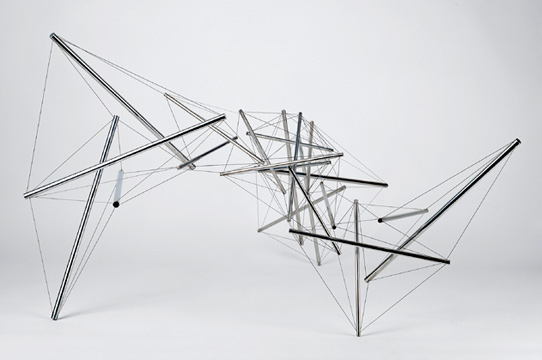
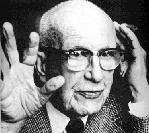
In TaiChi we usually use the word tension to mean blocked energy, either within part of the body or in the mind. However, the word really means a stretching or pulling and is used in mechanics to describe such a force, as opposed to compression which is a pushing or pressing force. Kenneth Snelson (sculptor) and Buckminster Fuller (architect) have described and built structures from rigid struts held together by flexible & sometimes elastic cords (see picture above), or loosely jointed (geodesic domes). Such structures are held together by tensile forces in the cords or joints rather like our own skeletons held together by ligaments, tendons and muscles. Snelson and Fuller have discovered that as long as the tension in the structure is evenly distributed over the whole (relaxed) then the structure has remarkable (tensile) strength and can withstand external pressures (attack) by absorbing the energy and elastically deforming (yielding). Any blockage or concentration of stress within the structure will result in weakness and possible breakage.
The word 'tensegrity' is an invention: a contraction of 'tensional integrity.' Tensegrity describes a structural-relationship principle in which structural shape is guaranteed by the finitely closed, comprehensively continuous, tensional behaviors of the system and not by the discontinuous and exclusively local compressional member behaviors. Tensegrity provides the ability to yield increasingly without ultimately breaking or coming asunder.

The great structural systems of Universe are accomplished by islanded compression and omnicontinuous tension.

Tension is the great integrity.

Truth is a tendency.
Buckminster Fuller

Note that tension, tendon, and tendency all stem from the Latin tendere meaning to stretch (as does tent and tenuous, surprisingly).

26 June 2005

Tension

The best way to release chronic tension from an area is to work it. Work is the healthy interplay of tension and relaxation. Power is the speed with which relaxed can become tense or vice versa. When something is worked it should have a rhythm like breathing lungs or a beating heart: an elastic give and take: an interplay of forces generally in equilibrium. This sort of work, free from constrictions or antagonisms, will benefit any living system by making it stronger and more fluid. A strong system is one that can tolerate greater stresses, one that has a large range between its relaxed state and its tensed one. Fluid means the movement between the two extremes flows like a liquid, the viscosity of which should be under your control: refinement. Working properly and becoming stronger will not only increase your maximal tension but will also increase your maximal relaxation.
Chronic tension sets in when the system refuses relaxation: when it chooses to remain in a tensed state: when it holds on. This could be due to stresses being repeated too regularly without allowing the system to properly recover/relax (not having the power to cope), e.g. a labourer who doesn't rest sufficiently between bouts of hard work: his muscles eventually forget how to relax. Or it could be due to a sudden unexpected or unusual stress/trauma which has caused so much fear that the resulting tension dare not be released. Either way, the tension eventually becomes natural to us and the only way to release it is through a practice that works on forgetting self. This, of course, requires the removal of the stresses that caused the tension long enough for the individual to gain enough strength to cope, and the attachment to at least an inkling of something better. I'm reminded of one of my teacher's cats, a brown Burmese who had undergone some trauma before we got her, causing her to be basically terrified of everything and anything. All the time we've had her (17 years) we have striven to give her only one message, that of love and affection, and gradually that fear has dissolved revealing a beautiful animal who possesses great courage: underneath the fear there was a warrior waiting to leap out. It's a miracle really but has made me realise how long it takes (almost a lifetime), that you really must remove yourself from the occasion of sin, as the Catholics say, and that underneath all that tension/ego who knows what you are. The meaning of life is to uncover your essential nature and then share it with the world: to learn to let your energy out. This is the crux of heartwork.
Rigor of beauty is the quest. But how will you find beauty when
it is locked in the mind past all remonstrance?
William Carlos Williams

25 June 2005

Responsibility


A consequence of our feelings for warriorship and destiny is a practical faith in the truth of what is unfolding before you. Yielding means going forwards into the world, entering it as it enters you, consuming it as it consumes you, being as active and as alive as reality itself: standing up to it like a man. This is a difficult proposition and to make a reasonable stab at it we must believe wholeheartedly and unflinchingly that what is happening to us now is what is meant to be happening, and is what needs to happen for us to proceed along the path of destiny. In the world of spirit there is nothing accidental or arbitrary, everything is pregnant with meaning and consequence, and everything conspires to drive us forwards. Once we start dipping into that world it will teach us by presenting us with challenges designed to hone and work weaknesses in our spirit. Everything that comes our way, almost by definition, we have the energy for, just. Challenges are not there to be shirked. We have to believe this or the world has no real meaning.

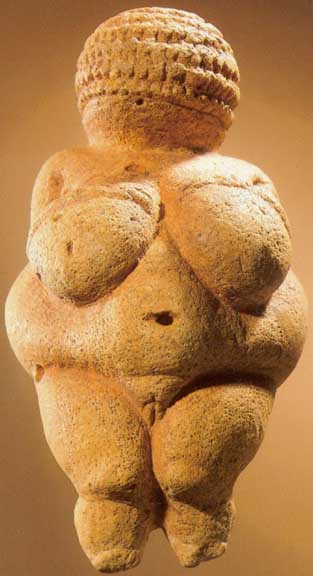
I recently saw the movie The 13th Warrior with a smouldering one-dimensional Antonio Banderas. It's worth catching for the depiction of the Viking way of life. They really were great warriors with a feeling for fate and a love of life (which includes death) that made them immense in their presence and bravery (one of them is called Herger the Joyous). Their enemies (in the film) were bizarre: primitive neanderthal types who all carried around Venus of Willendorf amulets and possessed the strength to rip a Viking head bare handedly from its shoulders (why does Hollywood spoil everything it puts its greedy hands on?). The characters were all captivating and utterly admirable mainly because, I suspect, they lived in the world rather than beside it. The trouble with our civilised middle-class existence is that it has been designed to shield us from spirit because the last thing the powers that be want is a populace of short-fused warriors making trouble. A good modern upbringing will try to instill the socially acceptable warrior qualities in its young by encouraging competitive sports. These develop many wonderful attributes but generally not the most important one - the ability to connect heart-to-heart and let your energy out instantly with no thought or qualification. Even (especially) competitive martial artists know nothing of this and the reason is because they are afraid of failure - they don't believe, in themselves, in spirit, or generally - they are not great lovers.
I believe in God
as fully physical
thus the Outer Predmost
of the World on which we 'hang'
as though it were wood and our own bodies are
hanging on it
Charles Olson: see comments page
Buckminster Fuller famously said "99% of who you are is invisible & untouchable". When you start working in the world of spirit the truth of this statement becomes apparent. Real useful natural intelligence is not the ability of your mind to solve complex problems, but allowing this 99% to come alive and operate for you. It is your better part because it is naturally connected - it is your divine aspect. When John's cat died last August (the most saintly creature I have ever known), John & I were thrown into this world of spirit & connectedness by the magnificence & perfection of his passing. For weeks afterwards our other bodies (our other 99%) were operating almost exclusively, especially when we worked together. We were throwing each other around simply by being & accepting. There was no need to join because we already were, through this third presence which was the spirit of the cat. This is another secret - that real connectedness always takes place through an intermediary - the third heart.

24 June 2005

Hi, Hot-and-Humid
That June she's a lush

Marshmushing, frog bickering
moon pooling, green gripping

fool
keep cool

Lorine Niedecker

Anyone can do it, but generally speaking,
few do. You can see it in the morning,
a subtle glimmer behind the glare. Whenever
treetops are brought plummeting down by
winter winds, lightning, or collisions, some
people, like animals, wake with a start. At
each evident instance, I start again. What
makes it seem one might be a perception
of ending, or it might be my refusal to
continue as I had been, as when, planning
or daydreaming or rehearsing recriminations,
I stop and notice that I am breathing again,
what color the moss is in this light, the
sounds no one is making

Steve Benson, from the ball (30 times in 2 days)

23 June 2005

Uprightness

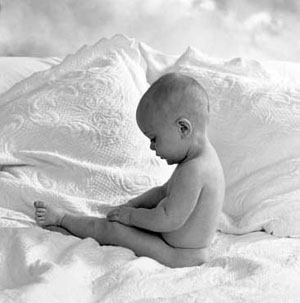
Unlike the 4-foots who have a direct heart connexion with the ground, and eye connexion with the thing infront of them, we have heart connexion with what we face, and a tenuous (at best) connexion with the ground through our limited 2-foot stance. The precariousness of our verticality is best seen in infants learning to walk. Pre-vertical they sit beautifully upright like little Buddhas, totally engrossed in their activity yet also totally connected to what surrounds them. When they crawl, or shuffle along on their behinds, they still look masters of their world, strength & mindset uncompromised by mobility, returning instantly to their seated composure once they've got there. However, things change as they try to stand up and take those first few steps. As well as uncertain balance, they just don't look right or comfortable when standing; suddenly insecurity enters their lives, not just the insecurity of a delicate balance but also the anxiety of reaching the object of desire quick enough. Add to this the pain of teething and they suddenly have to cope with a very different world. I suspect this is something we never quite recover from.

It is also remarkable how quickly children loose their natural flexibility once they start to walk, especially in the hips. I remember Max being able to get into full lotus with relative ease at 3 or 4, a flexibility that inspired Pip & myself into a few months of yoga (before we realised it lacked the humanity of connectedness). Now he can barely cross his legs when seated. It is just not really natural for our femurs to be at a greater angle than 90 to our spine. This is why, when doing TaiChi Form, the student is encouraged to sit into their posture (Dr Chi used to say "thighs parallel to ground" though I wouldn't recommend this - makes my knees hurt just thinking about it). We want the same openness in the hips and suppleness in the spine as a toddler, with the sure-footed confidence of a cat. The same way that a hollow chest encourages the energy in front of you to come in and connect (Liang used to talk of leaving the window open invitingly so that you can catch the burglar), a similar hollowness in the groin and hips should invite the ground up into your groin & belly. The legs should feel as though they are wrapping around something (weight on outside edge of foot). This consuming openness in the lower body should inspire the heart to open more so that your connexion with the ground is mirrored in your upper body connexion to the world in front. Think of the belly as a lower-heart. One of the major consequences of our upright, slighty leaning back, belly rising, sunk, relaxed posture is that the lower-heart & middle-heart (chest) join into one major organ of energy and connectedness. Body-as-one-unit requires the unification of our hearts. The upper-heart is the head. To bring this one in line requires you to forget the tyranny of sight. Instead of closing the eyes (never a good idea for a martial artist) concentrate on the peripheral vision and allow the head to move with the waist. Feel with the eyes rather than see with them. Also concentrate on the eyes in the back of the head (back-brain).
Eyes at the back of the head relax
and connect like hypothalmic threads.
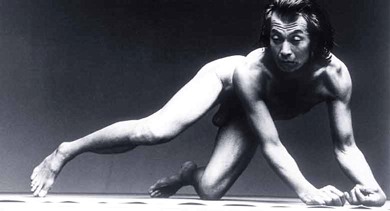
The physical chiasma is the crossing of the optic nerves in the brain. This point is the Taoist place of mind in meditation. The back of the head where the optic nerves travel to after crossing sprout energy limbs that come round into the fray, controlled mainly by our peripheral vision. Softening & relaxing the face (think a subtle widening smile) hollows the head and naturally brings us into our peripheral vision and consequently into the world of energy and connectedness. The head is the most difficult part of the body to bring in line because it is the usual (though not natural) place of thinking - the activity that disconnects us from the real world. I remember reading an article by the great Buto dancer Min Tanaka where he described an exercise he had developed to relax the neck and unify the head with the rest of the body. He recommended throwing yourself naked into a fast flowing mountain river. Apparently if the neck is relaxed it will flow with the rest of the body along with the current that carries it, around rocks & obstacles. However, if tense the head will tend to smash against these obstacles. Beautifully Japanese - you either learn or die.


Min Tanaka b.1945; with hair, unusual for a buto dancer.

22 June 2005

Verticality

In all likelihood, our ancestors first stood upright in order to survey the savanna into which they had ventured from the relative safety of the forest. Standing up allowed them to take stock of the horizon, all 360 degrees of it. This image holds today. Most of us lean forwards at least a little, engrossed in our fantasies, ambitions & agonies - the safety of self. Standing & moving properly vertical (with the sacrum under the sternum) puts us terrifyingly in the whole world - our hearts lift and spill to that horizon. Only when there is the possibility of this freedom from self do we have the responsibility of spirit.


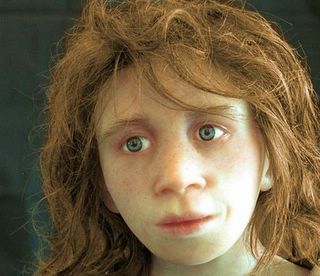
Modern reconstruction of a Neanderthal child. Note the red hair & blue
eyes, both characteristics we inherit from our Neanderthal ancestors.
John Kells feels much of the teaching coming through him dates from
times of ice.


magnetic congeries of genes
made-up of answers
Ronald Johnson

Love

The more we love, the more we know; and so reversed.
Melville

Love and work are the cornerstones of our humanity.
Freud

There is no remedy for love but to love more.
Thoreau

21 June 2005

Spirit

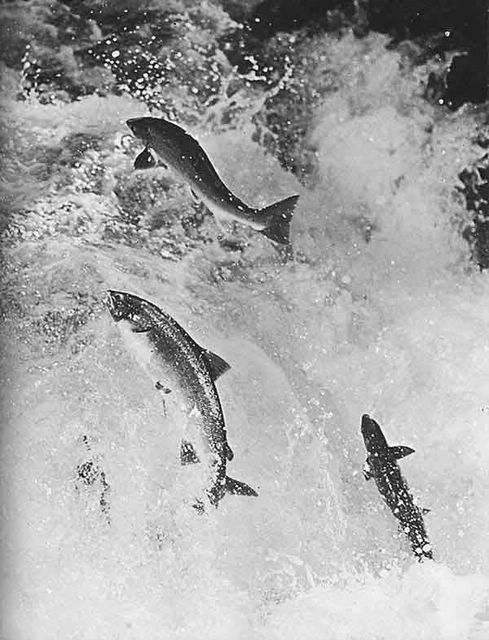
When spirit engages boundaries disappear. This doesn't mean that all distinctness disappears (in fact things become more distinct), but that language is no longer appropriate because description (separation) cannot exist. Poetry/metaphor conjures spirit - the energy of unification - whereas prose simply describes things in their state of (disconnected) repose. Connectedness implies & requires movement. Time does not exist in spirit: all linearity/continuity is fractured. The infinite is not vast expanse but discretized (digitised) intensity. Dynamic tension: in tension: intention: attention: (extension - contention). Reality a plethora of energy explosions. Mind so alive & awake it trembles & becomes the space between. The salmon of wisdom driving against the current - using frictional slippage planes to find a path through the morass.


Peace lies in finding the true war - Norman O Brown
         shifting
viewpoint
a step to the left
on this form
shifted
whereas
to the
right
now take a step

20 June 2005

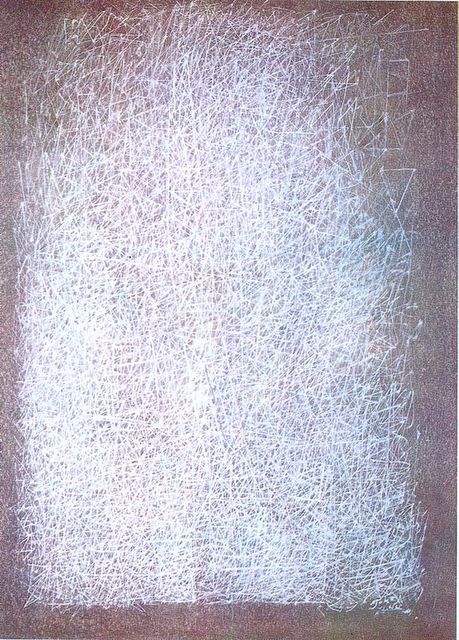
Sacred Mist


Mark Tobey

The one great eternal presence in our life is Mother Earth. The consequence of her presence & the field of our interaction with her is gravity, the force that binds us to her. Opening up & allowing her into every part of us (yielding to her - not resisting) opens us to the other side of the fact of her being - the opposite force to gravity which is an ethereal lightness which rises from her primal recesses - the sacred mist:
A mist ascends, clears the air,
and obliterates all landmarks.
Yielding is generative. It summons whatever is necessary to complete the picture. All great things are done by the force of opposites. It begets the opposing force through its action: attack naturally springs from yield. The yielding mind naturally opens to all aspects of reality.
Love is metaphysical gravity.
Buckminster Fuller

19 June 2005

A Way of Being


     A way of being

human

believe it. Then

the slightest

Advice to a student in exile

What we do now looks very different to what we did when you were with us 12 years ago but the principles are the same, & if you connect with us in your heart by doing your practice & staying true to what John transmitted then some of what we do now will come through into you. Energy & connectedness (the between energy - heart energy) do not obey the laws of space or time. In fact this is the key really to everything (certainly the secret of life), that spirit cuts through everything & connects directly, heart to heart, without the need for language, scientific models or pretty pictures.
When John left Dr Chi in Taiwan he asked him, "What should I practice when I'm back in London?"
After some musing Dr Chi replied, "I suggest you practice spirit".
Why do anything else?

18 June 2005

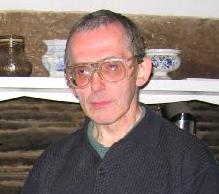
John Kells


Photo by Charles Bell
Yin & yang unite when the mind stops.
This insight comes in flashes as you face fear.
With correct practice these flashes become a steady stream of light.
You are truly blessed to know you have no choice.
I am with you out of time.
John wrote this poem in 1992 for Larry Koenig who was a student dying of leukemia. John would probably cut the Yin/yang reference now. In the last 15 years he has moved almost entirely away from the Chinese influence in his art and has concentrated on the Celtic/Irish connexion which comes through his family and other teachings he has received.

17 June 2005

Warriorship


On my post of 14 June entitled Yielding a person kindly added a comment: Yielding - soft like eyes welling up with tears heart in mouth unable to speak
I understand these feelings absolutely (& appreciate the poetry) - the poignancy of opening & connecting can often cause emotions to well up & catch one off guard, so to speak. However, these feelings, whilst admirable and a real indication of sensitivity & humanity, can only be registered & dwelt on if yielding has not taken place. If you are truly going forwards then even though these feelings 'happen' to you, you wont have time to 'feel' them - you'll already be onto the next engagement and the feelings will be shrugged off with irritation because they are irrelevant - you will be too in the thick of things.
Both TaiChi & HeartWork are martial arts - all about fighting. Many practitioners object to this, claiming that physical combat is an irrelevance in a modern civilised 'middle-class' existence, or arguing instead the case for self-defence - "I'm learning to defend myself in the unlikely event of an attack". However, the martial aspect of our work is crucial to being able to yield: the mindset of a successful yielder is that of a warrior, not of a victim. You basically have a choice between being a warrior or a victim, you can't usefully be a little of both (the epitome of double-weightedness - picking & choosing). A warrior lives every moment of her life meaningfully & with focus - directed toward the next battle. She doesn't allow herself to think in terms of self-defence because she knows that the best way to defeat an enemy is to take the fight to them and try to catch them off-guard. If you really live this sort of impeccable life then the last thing you'll turn into is a bully (another complaint against the martial way by the average victim) because by treating every moment of every day as a campaign against ignorance & fear (your two real enemies) then you learn to treat everything with respect because to be successful in this lifelong campaign you need all the allies & energy you can gather. The warrior way is the only way to travel deeper into the world of energy, spirit & connectedness. The sooner a student understands this the sooner they start to make real inroads into that world and stop skirting around the fringes. As John Kells says, "You are truly blessed to know you have no choice".