The proposition is a simple one: energy is larger than man, but therefore, if he taps it as it is in himself, his uses of himself are EXTENSIBLE in human directions & degree not recently granted. Quickly, therefore, the EXCEPTIONAL man, the “hero”, loses his description as “genius” – his “birth” is mere instrumentation for application to the energy he did not create – and becomes, instead, IMAGE of possibilities implicit in the energy, given the METHODOLOGY of its use by men from the man who is capable precisely of this, and only this kind of intent & attention.
Charles Olson, 1951
31 July 2005
Paradox of Yielding

Assi Ben-Porat
The point I'm trying to make about listening, softness, yielding, whatever you want to call it, is that it is all these things but is in no way passive. It gives way and receives but comes forwards at the same time. This is the paradox we need to struggle with. My dictionary defines soft as "presenting a yielding surface". How do we present? Dr Chi, in his struggle to explain softness to John on one occassion prodded his handkerchief which was lying crumpled on the arm of his chair. The handkerchief, being limp and light, gave way instantly, "This not yielding". Then he prodded the arm of the chair. The soft, foam-filled plastic gave way and allowed his finger to sink down, then, as he withdrew, the plastic of the chair stuck to and followed his retreating finger because the foam inside was springy. "This is yielding". Yielding has an elastic, consuming quality which, as it advances, accommodates oncoming energies, storing the energy of the impact or allowing that energy to stimulate a transformation. The chair is ready to "yield" all the time, it is only ever that chair, with the same unvarying properties and intention. To learn to yield or listen we must be similarly just one thing. My teacher used to say, "If you're cut, even your blood should yield". This is why we practice the Form day in, day out. It slowly anneals and tempers your energy, unifying your different aspects (mind, body, spirit). Body as one unit. However, this will only be healthy if the Form is allowed to develop with your developing energy. So often I come across Tai Chi practitioners of 20 years standing still doing their Form in the mechanical way they were taught it. Students have to realise that teaching and explaining a Form piecemeal ("...turn the waist to the right, transfering the weight to the left foot and holding a ball, now transfer to the right, turning to the left and step forwards...") gives only an approximation to the Form. These movements have to be strung together with energy through correct practice. Correct practice should be investigative rather than habitual. Like the Classics say, when doing the Form you should appear like a soft, beautiful woman, but inside you should be like a tiger ready to pounce. One sure way of stringing everything together is to practice with speed. Yang Cheng Fu used to do 30 Long Forms a day, each one taking no more than 12 minutes, which is double the speed we were taught. As I said before, Dr Chi recommended doing the Form three times per practice session (practising twice daily), firstly at a moderate speed, to relax and warm up. The second Form should be slow and sunk, making every effort to keep to correct form; by the time you finish this one your legs should be screaming in agony. The third Form is fast for spirit - light and playful. You should be able to instantly spring from slow/sunk to fast/light and back again. Remember that practising precisely what you are least inclined to want to practice will do you most good.
Two other things to remember. Firstly, Dr Chi once told my teacher that the Tai Chi we have now is only 2% of what the Chen family originally possessed. Secondly, the Yang Style Forms we have are the ones the Yang family felt happy to share with the world. There were also other Forms (fast, explosive Forms) which they never let out, presumably because they were too valuable and effective to share. So, in a sense, we only have half of the picture. Without learning to attack (to let your energy out) your yielding surfaces will not have the vibrant spring necessary to complete the conversation.
30 July 2005

Listening
Listening has nothing to do with the ears or the mind.
It is a matter of being present, being relaxed, being soft, being interested, being willing, being inviting, being lively.
I think John once used the words dwelling & lingering.
The feeling is as though you want each moment to last forever because it has so much detail and texture and beauty that it would take an eternity to do it justice.
Each moment is a deep pool that you fall into.
You practice listening in pushing-hands.
Feel the other: their presence, their warmth, their humanity, their suffering, where they're coming from and where they're going.
A sure sign of not listening is when the pushing-hands tends to speed up and gather momentum. This is a sign that you're 'getting off' on the energy of the interaction but have no real interest or compassion for the person in front of you.
Listening is not about riding the energy (any fool can do that) but about connecting, which involves letting your tentacles (your sensuality) explore and delve the moment - opening into the moment.
Everything touches. Listening is the investigation of this.
A listening person will have a soft light touch that insinuates and dwells with you. A feminine touch.
They forget themselves to be completely with the other.
They become the other, if only for a moment.
Yet with true listening each moment echoes through time and through your life, informing and enriching all other moments.
Life then is not "moving from one sensation to the next" but a heart directed richness with so much detail, texture and beauty that it would take an eternity to do it justice.
In fact it is an eternity.
It is a matter of being present, being relaxed, being soft, being interested, being willing, being inviting, being lively.
I think John once used the words dwelling & lingering.
The feeling is as though you want each moment to last forever because it has so much detail and texture and beauty that it would take an eternity to do it justice.
Each moment is a deep pool that you fall into.
You practice listening in pushing-hands.
Feel the other: their presence, their warmth, their humanity, their suffering, where they're coming from and where they're going.
A sure sign of not listening is when the pushing-hands tends to speed up and gather momentum. This is a sign that you're 'getting off' on the energy of the interaction but have no real interest or compassion for the person in front of you.
Listening is not about riding the energy (any fool can do that) but about connecting, which involves letting your tentacles (your sensuality) explore and delve the moment - opening into the moment.
Everything touches. Listening is the investigation of this.
A listening person will have a soft light touch that insinuates and dwells with you. A feminine touch.
They forget themselves to be completely with the other.
They become the other, if only for a moment.
Yet with true listening each moment echoes through time and through your life, informing and enriching all other moments.
Life then is not "moving from one sensation to the next" but a heart directed richness with so much detail, texture and beauty that it would take an eternity to do it justice.
In fact it is an eternity.
29 July 2005
The metallurgical analysis of the stone that was my heart showsJack Spicer, 1965
an alarming percentage of silicon.
Silicon, as George would be the first to tell you, is not a metal.
It is present in glass, glue and since glue is made from horses
- living substance.
I love you. But as the iron clangs, the glass, the glue, the living
substance (which, God knows, has been to as many glue
factories as it can remember) muffles what the rest of the
heart says.
I see you cowering in the corner and the metal in my heart
bangs. Too personal
The glass and glue in my heart reply. And they are living
substance.
You cannot bake glass in a pie or fry glue in an omelette
"If I speak in the tongue of men and angels..."
The sounding brass of my heart says
"Love."
The Teaching

The teaching is a living entity and like all living entities it requires and thrives on interaction, nourishment and challenge (stress). In a sense it resides within the teacher but it is also constantly at work beyond the teacher's realm, drawing in students, raw material (inspiration) so to speak ("the end of the world / is the borders of my being"). The difficulty for the teacher is to distinguish between his own energy and that of the teaching. Eventually it is all the teaching for which he is just the paltry conduit. This is why in a teaching situation the teacher learns as much as the students, if not more. He is more surprised than any at what comes out of his own mouth, his own movements and the comments and interactions from the class, all of which are expressions of the teaching. The charged teaching situation is an ideal arena for generating new material to keep the work fresh and exciting. So many times have I heard my teacher say, "This stuff would never have happened if I'd been working on my own". This is why the partner work is so important, even for relative beginners who only possess a little teaching, it allows that teaching to exercise itself in a larger and more healthy environment. The teaching is all about connexion, communication and interaction so it seems reasonable that it should be happiest when these are happening.
The teacher is at his purest and most impressive when he allows the teaching to express itself, rather than when he tries to express the teaching. There is nothing quite so off-putting and repugnant as pontificating and sermonizing. They are a sure sign of a lack of true teaching.
(This post was stimulated by an exchange below.)
28 July 2005
Getting older
Internal lessons can only be learnt at a certain age.
At 28/29 a person finds themselves at a spiritual juncture in their life. For me it was the time I started to live alone in order to concentrate fully on the Tai Chi.
It is well known in spiritual traditions that maturity comes at 36/37. At this age you make a connection to the internal that you could not before.
There is a saying - "A man of forty is not diverted". Nothing like realising you're half way through to focus your attentions. Before 40 a student's hardwork and intensity tends to be an exercise in willpower ("You must tenderise your will"). At 40 years of age something settles and your energy can go about the work more softly and effectively.
The age of 42 is also significant, but in a different way. An important change will often happen in your life.
There is another Taoist saying, "Life starts at 50". And another, "Life starts at 70" (TT Liang's - he may have made that one up), so I guess these must also be significant turning points.
Another one is meant to be around 60. My teacher certainly went through quite a change then - retirement from public teaching and a much deepened concentration on his own researches.
My teacher's father had his major spiritual breakthrough at 84 and he's still going strong at 87. He's a remarkable man. In his early 20's he had TB and wasn't expected to live long (he was a doctor so had no illusions). One day, during the war, he decided to go for a walk and after a few hours found himself on Hampstead Heath, praying to God to give him enough time and energy to see his children through their early years. In 1993, whilst recuperating from a heart bypass operation, he walked back to the same place and thanked God.
The Taoists consider the greatest misfortune to be an early death - not having the chance to learn life's lessons. Part of our tradition then is taking great care to stay alive long enough for the teaching to come to fruition within you. In the 80's my teacher once said to me, "Prepare yourself for a long life". I also remember him once holding up a hand to me in which his thumb and forefinger were held a few inches apart. He said, "For the rest of your life you'll be working hours each day on your Tai Chi and by the time you die you'll have changed this much", he emphasised the short distance between finger and thumb and I felt my heart dropping. He added, "Just hope it's enough".
It is well known in spiritual traditions that maturity comes at 36/37. At this age you make a connection to the internal that you could not before.
There is a saying - "A man of forty is not diverted". Nothing like realising you're half way through to focus your attentions. Before 40 a student's hardwork and intensity tends to be an exercise in willpower ("You must tenderise your will"). At 40 years of age something settles and your energy can go about the work more softly and effectively.
The age of 42 is also significant, but in a different way. An important change will often happen in your life.
There is another Taoist saying, "Life starts at 50". And another, "Life starts at 70" (TT Liang's - he may have made that one up), so I guess these must also be significant turning points.
Another one is meant to be around 60. My teacher certainly went through quite a change then - retirement from public teaching and a much deepened concentration on his own researches.
My teacher's father had his major spiritual breakthrough at 84 and he's still going strong at 87. He's a remarkable man. In his early 20's he had TB and wasn't expected to live long (he was a doctor so had no illusions). One day, during the war, he decided to go for a walk and after a few hours found himself on Hampstead Heath, praying to God to give him enough time and energy to see his children through their early years. In 1993, whilst recuperating from a heart bypass operation, he walked back to the same place and thanked God.
The Taoists consider the greatest misfortune to be an early death - not having the chance to learn life's lessons. Part of our tradition then is taking great care to stay alive long enough for the teaching to come to fruition within you. In the 80's my teacher once said to me, "Prepare yourself for a long life". I also remember him once holding up a hand to me in which his thumb and forefinger were held a few inches apart. He said, "For the rest of your life you'll be working hours each day on your Tai Chi and by the time you die you'll have changed this much", he emphasised the short distance between finger and thumb and I felt my heart dropping. He added, "Just hope it's enough".
27 July 2005

Energy & perception
About 30 years ago I read of a tribe of African pygmies who believed that as objects move away from you they actually shrink in size. At the time I laughed and scoffed (being a budding scientist for whom space and time were absolutely linear), but now I'm delighted by such a world view. It implies a rich interdependence where significance depends upon proximity, where space is distorted by the objects within it, and where the world of objects and the world of relationships are intimately bound up.
We have already established that perception depends upon posture: when you are correctly aligned you connect better: you feel things more acutely and your presence is more immediate in the sense that your energy is more readily available. This is clear in martial interactions: correct posture improves your performance, otherwise we wouldn't bother with it.
Perception also depends upon energy. As your energy improves with the work we do your perceptive powers deepen. So does your understanding. For this reason arguing with your teacher, or doubting them, is ridiculous. They will always see and feel more deeply than you: they are better connected. If you ever overtake them then the teaching was not a living internal one and you've been wasting your time.
It is very important to look after your energy. The biggest drain is bad company. Unfortunately this often means family and friends: people who are in the habit of regarding you in a certain way. The Tibetans say that the biggest hindrance to spiritual progress is your family. As you progress in your Tai Chi your energy will improve and you will start to change as a person. It is vital that those closest to you recognize, approve and admire this otherwise you will have a needless and draining battle on your hands (one reason teaching others is so good for you - your students and spiritual companions naturally regard you correctly). The best way for them to show their admiration and appreciation is to join you in the journey and take up Tai Chi or something similar themselves. If they don't then I'd either move on or be very careful about the time and energy I put into the relationship because it wont be long before you either leave them behind or start to be held back by them. My sister once said to me, "It is so much better to be on your own than with the wrong person". To behave this ruthlessly you must believe that this work is your life and is vital not just for your own salvation, but for everything you are connected to (which ultimately is everything). Such changes will happen naturally if you do what you do openly and freely and don't repress and don't hold back. As they say, "Follow your heart".
We have already established that perception depends upon posture: when you are correctly aligned you connect better: you feel things more acutely and your presence is more immediate in the sense that your energy is more readily available. This is clear in martial interactions: correct posture improves your performance, otherwise we wouldn't bother with it.
Perception also depends upon energy. As your energy improves with the work we do your perceptive powers deepen. So does your understanding. For this reason arguing with your teacher, or doubting them, is ridiculous. They will always see and feel more deeply than you: they are better connected. If you ever overtake them then the teaching was not a living internal one and you've been wasting your time.
It is very important to look after your energy. The biggest drain is bad company. Unfortunately this often means family and friends: people who are in the habit of regarding you in a certain way. The Tibetans say that the biggest hindrance to spiritual progress is your family. As you progress in your Tai Chi your energy will improve and you will start to change as a person. It is vital that those closest to you recognize, approve and admire this otherwise you will have a needless and draining battle on your hands (one reason teaching others is so good for you - your students and spiritual companions naturally regard you correctly). The best way for them to show their admiration and appreciation is to join you in the journey and take up Tai Chi or something similar themselves. If they don't then I'd either move on or be very careful about the time and energy I put into the relationship because it wont be long before you either leave them behind or start to be held back by them. My sister once said to me, "It is so much better to be on your own than with the wrong person". To behave this ruthlessly you must believe that this work is your life and is vital not just for your own salvation, but for everything you are connected to (which ultimately is everything). Such changes will happen naturally if you do what you do openly and freely and don't repress and don't hold back. As they say, "Follow your heart".
26 July 2005
Webs beyond the reach of shallow
Reality is the vast web of connectedness.
Each entity vibrates, breathes, and communicates.
Space and time between entities does not really exist: communication is out of time.
True communication is always before: this is destiny.
The only way to change the world is to change yourself.
Vibrate, breathe and communicate more fully.
Vibrate at a higher frequency (more energy), breathe at a lower frequency (more deeply), and move forwards to connect more completely.
Become more extreme: increase your range of influence.
These changes must be internal: of the spirit and energy.
External change induces tension.
Internal change requires relaxation.
And permeates reality.
Such is softness.
These sleepy notes are typed in a room thick with the dreaming of two sleeping children.
Each entity vibrates, breathes, and communicates.
Space and time between entities does not really exist: communication is out of time.
True communication is always before: this is destiny.
The only way to change the world is to change yourself.
Vibrate, breathe and communicate more fully.
Vibrate at a higher frequency (more energy), breathe at a lower frequency (more deeply), and move forwards to connect more completely.
Become more extreme: increase your range of influence.
These changes must be internal: of the spirit and energy.
External change induces tension.
Internal change requires relaxation.
And permeates reality.
Such is softness.
These sleepy notes are typed in a room thick with the dreaming of two sleeping children.
25 July 2005
Transmission of Energy

Replying to a comment yesterday made me appreciate just how powerful a living energetic teaching is. And how dangerous if abused. My teacher always talked of a transmission of energy. When he gives instruction there is an energy given, round about the same time that the words are voiced, which is the true instruction. It is this transmission of energy that enables the student to correctly interpret the verbals. The words are very crude and blunt compared to the energy which is finely nuanced (although at the time the student may feel it as a brutal blast). Without the energy the words may as well have come from a book. The teacher chooses his time carefully since the student must be caught at just the right time otherwise the teaching will not penetrate. The teacher feels an opportunity for some aspect of the teaching to express itself in the student's presence, always due to the student's energy having opened up in some way, and will quickly apply the gentle pressure the teaching is. The student must make sure she stays open for the duration of the transmission (usually very short), and must then go away and start the arduous struggle of retrieving and working with the energy she has been gifted. The transmission is like a seed and the student's work and respect and whole-heartedness is the nourishment the seed needs to grow. You can see now that teaching energy is a delicate business and requires the presence of the Master. Without it the student's energy may well improve and strengthen, but it wont belong, and wont bear the rich fruits of the lineage.
                                                    the Heart is a clock
                                                    around which clusters
                                                    or which draws to itself
                                                    all which is the same
                                                    as itself in anything
                                                    or anyone else the
                                                    power of itself lies
                                                    all about itself in
                                                    a mathematic of feeling
                                                    which we call love
but who
love itself is the container
of all feelings otherwise than love
as well
                             as the Heart equally
                             holds all else there is anywhere
                             in Creation, when it is
                             full
Charles Olson 1968
I’d want her eyes to fill with wonder
I’d want her lips to open just a little
I’d want her breasts to lift at my touch
And O I’d tell her that I loved her
I’d say that the world began and ended where she was
O I’d swear that the Beautiful wept to see her naked loveliness
I’d want her thighs to put birds in my fingers
I’d want her belly to be as soft and warm as a sleeping kitten’s
I’d want her sex to meet mine as flames kissing in a dream forest
And O I’d tell her that I loved her
I’d say that all the noblest things of earth and heaven
Were made more noble because she lived
And O I’d know that the prettiest angels knelt there
As she lay asleep in my arms
Kenneth Patchen 1946
I’d want her lips to open just a little
I’d want her breasts to lift at my touch
And O I’d tell her that I loved her
I’d say that the world began and ended where she was
O I’d swear that the Beautiful wept to see her naked loveliness
I’d want her thighs to put birds in my fingers
I’d want her belly to be as soft and warm as a sleeping kitten’s
I’d want her sex to meet mine as flames kissing in a dream forest
And O I’d tell her that I loved her
I’d say that all the noblest things of earth and heaven
Were made more noble because she lived
And O I’d know that the prettiest angels knelt there
As she lay asleep in my arms
Kenneth Patchen 1946
24 July 2005
Peace of Mind
Did any of you see the series called Tribe on BBC2 a while back. The series that gave Bruce Perry the chance to try out some exotic natural narcotics. My favourite from the series was the Mongolian one where Perry lived for a month with a nomad family, 'helping' them relocate to winter pastures. At one point Perry asks the father and head of the family, a magnificent, handsome man in his late twenties or early thirties, what the most important thing in his life was. He answered without hesitation, "My peace of mind and my work". When his wife, the mother of his children, was asked a similar question she said, "The family". Both of them explained that if they lived in the city their life would be easier but not as free. Their lack of material attachments, whilst making their day to day existence more precarious, gave them more peace of mind and settled their soul. In a sense, peace of mind and none attachment amount to the same thing. The Tibetans say that your problems are as big as your possessions. When my son Max was born in 1992, my teacher's advice was, "Love him with all your heart but don't get attached". Peace of mind only comes when you have ruthlessly thrown off everything sucking at your energy. Dr Chi once said, "If you stick to someone, they stick to you too." Attachment works the same way, it is always two-way. So how does one not get attached? How do you not allow things to stick to you? Attachment and sticking both imply that some steady state has been reached, that there is some stability (continuity) to the sticking interface: two items joined together at some point. If your energy is vorticular then this will never happen, everything in your environment will be in a process of being consumed by you, either taken in, or expelled. There is no such thing as steady state or stability and so there is no attachment or sticking, not for more than an instant anyway. In the vorticular world reality is non-continuous. It is a plethora of instants - instantaneous explosions - from all times and places. In such a world there is no past, present and future because the timeline is as fractured as every other aspect.
Try this exercise. Sticking.
Two people together. Both standing, one in front of the other. One (the sticker) is relaxed and limp. The other (the stickee) slips the back of her left hand under the right hand of the sticker and lifts it up. The sticker's arm should remain as limp as possible so that the stickee feels the dead-weight of the sticker's arm as the hand is lifted. The stickee then moves around the room taking the sticker with her. The idea is to maintain contact through the hands at all times. OK, pretty boring eh? Now if the sticker starts to bring some life and spirit into their hand then the touch will lighten. Keep on bringing more and more life and spirit into the situation and you will both feel that the area of contact wants to shift and roll, to breathe. The spirit should gently insinuate through the contact into the other person. There should come a point in this increasing intensity between you when the physical contact becomes an irrelevance. Both of you should be swarming all over and through the other. The only way to survive the others consuming intensity is your own consuming intensity. You will see that this world of spirit is not a stable world. It requires almost instant resolution (in a self-defence situation this would be the defeat or death of one of the parties). However, if both of you cooperate and work to the same end then that vibrating and dangerous world can be touched safely. This is Heartwork. You come away unharmed but changed forever. With practice all your interactions are heartfelt and heart-driven and every moment is a transforming one. As I said before, the wonder of life is that there is always a miracle wanting to happen.
Try this exercise. Sticking.
Two people together. Both standing, one in front of the other. One (the sticker) is relaxed and limp. The other (the stickee) slips the back of her left hand under the right hand of the sticker and lifts it up. The sticker's arm should remain as limp as possible so that the stickee feels the dead-weight of the sticker's arm as the hand is lifted. The stickee then moves around the room taking the sticker with her. The idea is to maintain contact through the hands at all times. OK, pretty boring eh? Now if the sticker starts to bring some life and spirit into their hand then the touch will lighten. Keep on bringing more and more life and spirit into the situation and you will both feel that the area of contact wants to shift and roll, to breathe. The spirit should gently insinuate through the contact into the other person. There should come a point in this increasing intensity between you when the physical contact becomes an irrelevance. Both of you should be swarming all over and through the other. The only way to survive the others consuming intensity is your own consuming intensity. You will see that this world of spirit is not a stable world. It requires almost instant resolution (in a self-defence situation this would be the defeat or death of one of the parties). However, if both of you cooperate and work to the same end then that vibrating and dangerous world can be touched safely. This is Heartwork. You come away unharmed but changed forever. With practice all your interactions are heartfelt and heart-driven and every moment is a transforming one. As I said before, the wonder of life is that there is always a miracle wanting to happen.
23 July 2005
Vortex of Heartwork
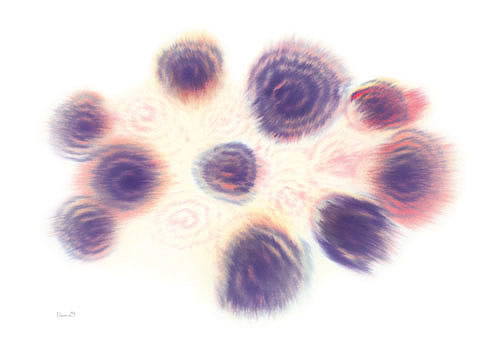
Hugh Kenner's vortex quote from yesterday is really quite profound:
the vortex is not the water but a patterned energy made visible by the water
It indicates how your energy should be used in Heartwork. It should effectively create an energised environment (vortex) through which your immediate world is consumed and transformed. If you manage this then your immediate world also becomes a vortex through which you are consumed and transformed. Heartwork is different from Tai Chi in this respect. In Tai Chi we strive for balance. So if one person attacks then the other yields so that the interaction is balanced (the Tai Chi yin/yang symbol). However, heartwork is about transformation. You use your heart in such a way that you transform yourself (become a vortex) and you transform your environment into an image of yourself (another vortex). This is a fractal reality. A reality full of self-similar generation. So in a Heartwork Intensive we gradually, over the space of 5 hours, build up a complicated and elaborate posture from a simple figure of eight unit. When this posture is done quickly and with spirit it comes alive - becomes a vortex - and the more you repeat the posture the more like the posture your energy becomes. You become the posture. You become the vortex. When we then try the posture out on each other we find that when you attack into one of these vortexes that you become a similar vortex. The Intensive is then a collection of madly flailing, writhing, gyrating vortices, and the class itself becomes another vortex. When the students go home they take this vorticular energy away with them and through their commitment and practice they transform their own lives and environments. The Community of Heartwork (I love this phrase of Fionnan's) becomes another vortex.
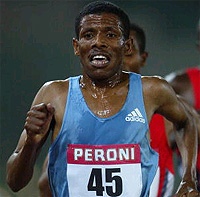
Athletes generally have little understanding of this use of energy. They will strive to become a human machine, an object that uses fuel to generate energy which does work to complete a specific task (Lance Armstrong would be the epitome of this). This has nothing to do with connectedness or transformation and consequently the athletic pursuit does not improve the person. However, it is obvious that a few of the top athletes have realised that if they reach out with their heart to the spectators (and God) then a two-way transformation is achieved which gives the athlete enough extra energy to excel himself. Haile Gebrselassie immediately comes to mind. If you watch him run you can see that it is all heart. The fact that he is a beautiful human being who does much charity work is no surprise.
Athletes generally have little understanding of this use of energy. They will strive to become a human machine, an object that uses fuel to generate energy which does work to complete a specific task (Lance Armstrong would be the epitome of this). This has nothing to do with connectedness or transformation and consequently the athletic pursuit does not improve the person. However, it is obvious that a few of the top athletes have realised that if they reach out with their heart to the spectators (and God) then a two-way transformation is achieved which gives the athlete enough extra energy to excel himself. Haile Gebrselassie immediately comes to mind. If you watch him run you can see that it is all heart. The fact that he is a beautiful human being who does much charity work is no surprise.
Diet
Someone kindly left a comment on the Fear & Diet post below. It is an argument I've come across before and needs attention so I'll answer it here. The comment:
I'd go with the meat comment. It definitely has a negative effect on my emotions, usually the following day. However, a few years back when I was extremely run down meat was the only food that enabled me to rebuild my strength. Some people thrive on a vegetarian diet, some people seem to need some meat. Evolution. We have been eating meat for millenia and can't be expected (as a species) to change overnight.My reply:
I'm not sure I buy these arguments. I'm sure if you'd spent more time & intelligence rebuilding your strength on a vegan diet your energy would have benefitted. I have a lot of experience of students going vegetarian or vegan and then complaining to me that they feel weak or rundown. I'm usually standing in front of them listening to this and marvelling at the same time how much freer and stronger and more refined and lighter their energy feels. My teacher always says that the way you feel is only an opinion of the way you are. The image he used to use was that of ships bobbing up and down on the ocean. The movements of the boats are your feelings. The ocean however is your energy. One is not necessarily an accurate image of the other. If you were a habitual smoker and gave up overnight you'd feel bad for weeks. Maybe it's the same when giving up unhealthy anything, including food or bad company. No one needs meat. Some people may need more protein than others. This can always come from a vegan source. It just takes time for the body to adjust. A vegan or vegetarian diet also needs more care and attention that a meat diet. The food resides within you for a much shorter time (reducing chances of cancers and other ailments of the alimentary canal) but also making you feel hungry more regularly. A good diet must be planned and balanced carefully. Like I said before, it depends how far you're prepared to go.
22 July 2005
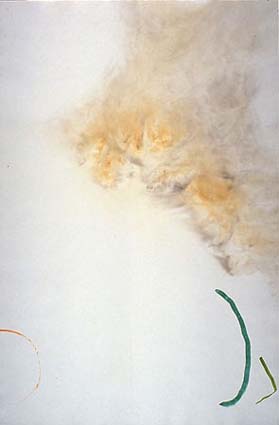
River Rocks and Smoke #8 4/10/90 John Cage
"To make the smoke prints, we rolled up newspaper and built a fire right on the press, Then we placed dampened paper over the fire, which of course put out the fire and produced smoke. Then we rolled the paper through the press, leaving the imprint of the smoke on the paper."
The Flower
I think I grow tensions
like flowers
in a wood where
nobody goes.
Each wound is perfect,
encloses itself in a tiny
imperceptible blossom,
making pain.
Pain is a flower like that one,
like this one,
like that one,
like this one.
Robert Creeley
like flowers
in a wood where
nobody goes.
Each wound is perfect,
encloses itself in a tiny
imperceptible blossom,
making pain.
Pain is a flower like that one,
like this one,
like that one,
like this one.
Robert Creeley