“A poem is energy transferred from where the poet got it (he will have some several causations), by way of the poem itself to, all the way over to, the reader . . . the poem itself must, at all points, be a high energy-construct and, at all points, an energy-discharge.” Charles OlsonThis could equally describe correct Tai Chi. We relax not to drift through our Form flaccidly and absent-mindedly but to better access our energy and its sources – to better connect – and to better (more accurately) express that energy. The more relaxed you become the more intensity and energy you can give your work, and the more detail, texture and intricacy can naturally express themselves in that work (energy). Each solo practice session starts with simple warm-up exercises. These loosen the body and help the mind abandon its worries and concerns, at least for the duration of the practice. The more simple – the bigger the circles – the more effective they are. As the mind and body relax into an exercise, energy starts to flood the body, invigorating, enthusing and interesting the spirit which rises to do its job of rallying and coordinating the troops (your different facets). Once the spirit becomes involved you enter a different reality. This reality does not obey the usual laws of space and time. Things do not necessarily have their place, do not require spatial or temporal proximity to affect, and things do not necessarily follow one from another – cause and effect are fractured. When the spirit is roused then energy expresses itself very differently. It plays and glories in that play – it doesn't need a reason. Each part of the whole becomes charged and spirited, and each wants to break away and affirm its independence, and it is precisely this obstreperousness, which the heart manages to swallow and hold together, that gives your movements and presence and existence vibrancy, vitality and potency – it reaches out and infects your environment. It also brings alive all the connexions you've ever had, plus interesting genetic peculiarities trying to express themselves through your energy, and opens you to the possibility of future connexions necessary to fulfill your destiny. This is high-energy indeed, and so rich, multi-faceted and deeply textured that the mind can in no way fathom or explain; not only are there far too many variables to comprehend but the reality in which these variables come together is damaged and constricted by rational thinking. The rational mind, and its servant – language – do not fair well in the heartworld. They are not passionate enough. This is why poets must constantly search for new and peculiar ways of using words – putting them together – each time they work they must charge them anew otherwise they wont have any bearing on the reality they are attempting not only to elucidate but to more deeply enter. (You progress in the sense that the tunnel you are digging gets deeper.) Each time is the first – and the last. Or, as my teacher has put it, “revere the work by honouring each moment as the last but first.”
28 January 2006
Spirit
27 January 2006
Philip Whalen's Hat
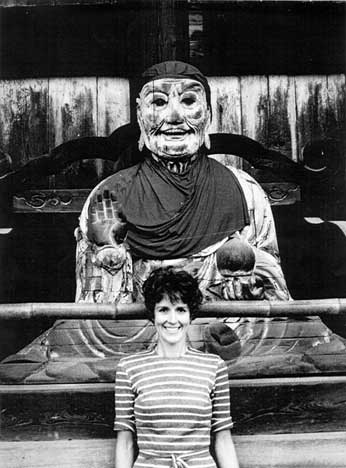
I woke up about 2:30 this morning and thought about Philip's
hat.
    It is bright lemon yellow, with a little brim
    all the way around, and a lime green hat band, printed
    with tropical plants.
                           It sits on top
    of a shaved head. It upstages every thing & every body.
He bought it at Walgreen's himself.
I mean it fortunately wasn't a gift from an admirer.
Otherwise he is dressed in soft blues. And in his hands
a long wooden string of Buddhist Rosary beads, which he keeps
moving. I ask him which mantra he is doing - but he tells me
in Zen, you don't have to bother with any of that.
You can just play with the beads.
Joanne Kyger
26 January 2006
Searching for the Wrong-Eyed Jesus

“I used to live in New York City and I'd ride my bike over that damned Brooklyn Bridge everyday and there was a white line on it and I used to try to get my bike to sit right on the white line – I'd be going 40 miles per hour – try to get my bike to sit right on that white line – the tyre to touch it – and I noticed if I looked down directly at where my tyre was I could never keep it on the white line but if I looked up and sort of glazed my view of things that I could keep it right on the white line. It was a peculiar awakening that sometimes if you look directly at something it's inapprehendible. Sometimes you gotta look away before you can achieve something.”
Jim White
This beautiful documentary was on TV the other night. An atmospheric journey through the deep white South (USA) with musical interludes so well integrated that they define the movie as much as the imagery and the simple spoken wisdom. Will be available on DVD (in the UK) at the end of the month.
Jim White
This beautiful documentary was on TV the other night. An atmospheric journey through the deep white South (USA) with musical interludes so well integrated that they define the movie as much as the imagery and the simple spoken wisdom. Will be available on DVD (in the UK) at the end of the month.
25 January 2006
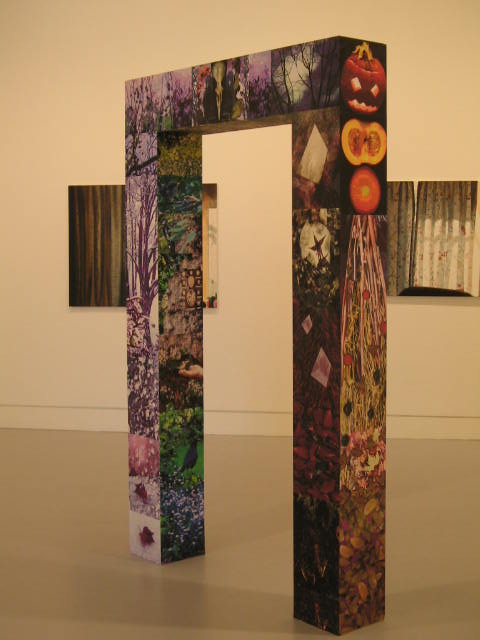 Forever Changes, the Janus Gateway, by Jane Colling.
"In Roman mythology, Janus was the god of gates and doorways, beginnings and endings, of change and transition such as the progression from past to future, from one condition to another, one vision to another and one universe to another. He presided over all that is double-edged in life, representing the passage between barbarity and civilisation, the rural and the urban, youth and adulthood. As herald of the Golden Age, he introduced what was then termed ‘culture’: money, laws and agriculture. When the doors to his temple in Rome were open, it signified the city was at war; when they were closed, Rome was at peace. Rarely were those gates shut...Janus is usually depicted as a double-faced deity, looking simultaneously in opposite directions. Originally, one face was bearded, one clean-shaven. He also holds a key. The first month of the year was named after him: January." Cafe Gallery blurb
It is at Jane's house that we have the London Heartwork Intensives.
Perhaps showing her age with that title - I remember my hippie mother playing that record all the time when I was a kid.
The Talking Jewel
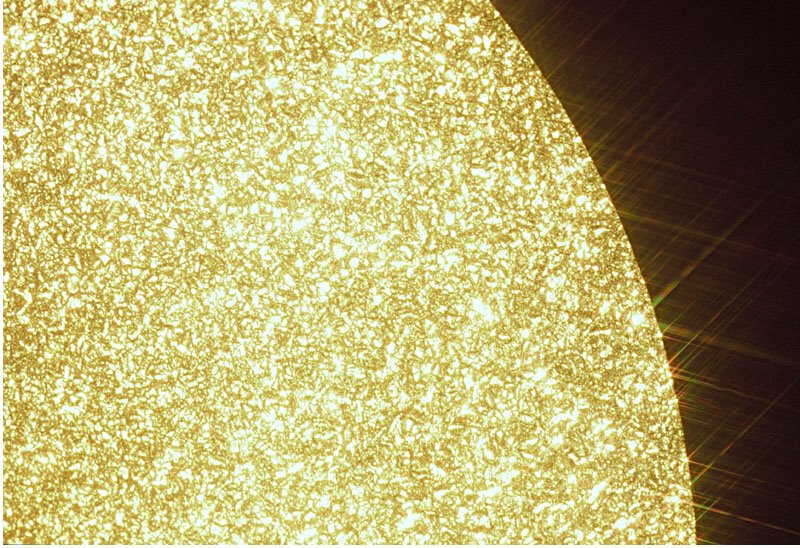
Back in 1980 I worked as a mathematical consultant at De Beers' Diamond Research Laboratories in Johannesburg. I had been led to believe that diamonds only came alive when cut, so was surprised at the beauty of the uncut diamonds I handled there. Some were as big as conkers. They really did have and emit energy – they glowed from within – they weren't just reflecting and refracting light from without. The jewel in the heart has similar qualities. It is like a fine glass phial of essence in the heart – probably more of the soul than the heart – that glows and sparkles, casting its light in a shimmering array all around, but especially up and around, which is why we need our special posture – the sacrum must be directly under the heart to achieve that upward thrust naturally. “It talks all the time, and it talks with everything,” was the way John put it. Intensely communicative. Communication is its essential quality – it is always casting out, never content to stay within. Even when practising alone this is the case. What makes solo work heavy is the tendency for your energy to stay within – working on itself – doing rather than giving. If you work this way then you'll develop power – physical and energetic – but you wont become a better person – one better able to connect and exercise compassion. When practising try to bear this in mind. Imagine (remember) what it's like to be with a good friend, inspired and bouncing ideas and images and energy off each other – light and excited. Let the jewel in your heart talk similarly with the work and with the Tao. Sometimes I'll even talk out loud, as though explaining things to an imaginary student (myself). It awakens the spirit of communication which is, after all, what the work is all about.
"When I put a green, it it not grass. When I put a blue, it is not the sky."
"I interpret nature and submit it to the spirit of the picture."
Henri Matisse
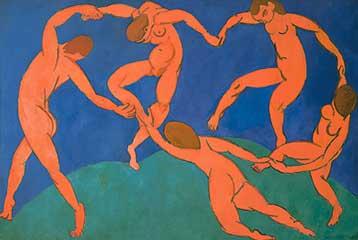
"I interpret nature and submit it to the spirit of the picture."
Henri Matisse
It was the uprush of violence as much as the earthy physicality of the finished work that shocked people. Matisse said he himself took fright, like the Douanier Rousseau, who sometimes had to open a window to let out the elemental force of his own painting. In Dance and Music, Matisse attempted simultaneously to release and contain that force. "At the precise moment when raging bands were milling about in front of his huge canvases, tearing him to pieces and cursing him," wrote Sembat, "he confessed coolly to us: 'What I want is an art of balance, of purity, an art that won't disturb or trouble people. I want anyone tired, worn down, driven to the limits of endurance, to find calm and repose in my painting'."
Hilary Spurling, from Matisse the Master, vol 2, which won the Whitbread Prize last night.
24 January 2006
Added Precisions
Revere the work
Restore the essence
Reveal the teaching
Relate the marrow (to the bone)
Reclaim the voice
John Kells
Restore the essence
Reveal the teaching
Relate the marrow (to the bone)
Reclaim the voice
John Kells
Listziana, Much Later
I sit in your T shirt
with its spots of paint
as a certain fierceness pours
outside, perhaps, too, on you.

I'm smoking a Camel now
and have a big hole in my
shoulder from washing away
a lot of dirt. Are you there?

there, are you? I am here
and the storm is not enough,
it should crash in and wet,
there should be maelstrom where

a privileged host is smiling.
And naked in debris I there
should be, but, being here, should
bend to you, pick out of rubble

a scrap of painted shirt
as if it were soiled ivory from
a grand piano, possessed of us
both, and ruined now by storms.
Frank O'Hara
Foot to Spine
An interesting correspondence is between the foot and the spine. Heel corresponds to the base of the spine and the toes with the crown of the head. This is one reason the Tai Chi postures with only the heel of the front foot on the ground (Lifting Hands, Play Guitar) feel so different to postures with the only the toes (or ball) of the foot on the ground (White Crane, High Pat On Horse, Seven Stars). When the heel is firmly planted then the base of the spine wants to drive down into it. When the toes only are on the ground then the head naturally wants to crane forward and the energy is clearly felt in the crown. Also when lifting a foot to step the heel rises first and the toes linger on the ground a little, this brings a little liveliness and lightness up the spine to the headtop (just what's needed to manage the step nimbly). When placing the foot back on the ground the heel hits the ground first (unless stepping back), firmly planting the base of the spine and allowing a wave of relaxation to pass down the spine and the legs, and a wave of energy to pass up the spine from the tail to the crown, as the whole foot makes contact. We recommend pointing the toes at the ground immediately prior to placing the heel. If you do this then try to feel the shift from crown to coccyx. You could even try pointing toes, heel, toes and then placing the heel on each step. This brings flexibility to the spine and the mind, and improves balance.
22 January 2006
Further Notice
I can't live in this world
And I refuse to kill myself
Or let you kill me.

The dill plant lives, the airplane
My alarm clock, this ink
I won't go away

I shall be myself -
Free, a genius, an embarrassment
Like the Indian, the buffalo

Like Yellowstone National Park.
Philip Whalen (1923-2002)
The Choiceless Choice
The trouble (or excitement) in entering the world of energy, especially heart (energy), is that the mind loses its dominion and the world begins to shift. It begins to shift into deeper ground – where the mind's convictions no longer convince – no longer provide a rigid set of landmarks by which to navigate an emotional and physical course through the day. The courage we talk about in the work is the courage to allow these shifts without immediately grasping and clinging onto the mind's paraphernalia as it disappears from view. It is my teacher's approach to concentrate on the positive rather than eschew the negative. So the mind relaxes (loses its grip) not because we have practised no-mind but because we practice all-heart. This is extremely important and is the key to success. To progress by making a series of adjustments, whether physical (postural), technical, or even energetic is torturous and long-winded in the extreme. It is not natural and will never have a feeling of ease as the natural should – it will be what my teacher calls “working against the grain.” What is required is a simple switch of allegiance, from mind to heart. This is what my teacher calls the choiceless choice. The reason your teacher adjusts your posture in class, or gives technical instruction, is not really to make your Tai Chi any better but simply in the hope that it may help you make that choice – it may thrust you into the heart from which you may not wish to return. The teacher's presence would be enough if you let it. The difficulty, as always, is what to do when you don't have it – how to proceed when you no longer have that pillar of strength in your midst. My teacher would always say work with the energy not the technique. By this he means softly, gently, without force, trying to find the heart in the adjustment he has given – searching for the internal and how that manifests in more heart and, most importantly, in better connexion when confronted by another being. How completely can you be with the other. Power and stability never come into it because a heart-to-heart connexion is out of the bounds of your control and any attempt to control it will ruin it. It should be the controller not you. It should be your teacher.
20 January 2006
19 January 2006
The Artist
The artist: disciple, abundant, multiple, restless.
The true artist: capable, practising, skillful; maintains dialogue with his heart, meets things with his mind.
The true artist: draws out all from his heart, works with delight, makes things with calm, with sagacity, works like a true Toltec, composes his objects, works dexterously, invents; arranges material, adorns them, makes them adjust.
The carrion artist: works at random, sneers at the people, makes things opaque, brushes across the surface of the face of things, works without care, defrauds people, is a thief.
The true artist: capable, practising, skillful; maintains dialogue with his heart, meets things with his mind.
The true artist: draws out all from his heart, works with delight, makes things with calm, with sagacity, works like a true Toltec, composes his objects, works dexterously, invents; arranges material, adorns them, makes them adjust.
The carrion artist: works at random, sneers at the people, makes things opaque, brushes across the surface of the face of things, works without care, defrauds people, is a thief.
Denise Levertov (from the Spanish translation of Toltec Codice de la Real Academia. With the help of Elvira Abascal who understood the original Toltec.)
18 January 2006
Perfection's Soul
I like the two comments yesterday because they both highlight different aspects of the work. The key not just to softness but to spiritual progress is perfection's soul. If the student doesn't have a deep feeling, indeed yearning for this then there is not much hope. And that yearning is felt not so much as a need or a magnanimous urge/surge but as an ache in the heart. Maybe yearning isn't the correct word either. Feeling and yearning both have a selfish content – whilst you're feeling or yearning the actual manifestation of that soul, within and without, is probably passing you by. The magnanimous – the great soul – is not something you possess or bestow – it is the wake up call that's all around all the time – humbling and overwhelming: “Awakened / by the ticking / not the alarm.” Touching perfection's soul is most difficult – your hand is always too heavy. The secret is to lay yourself alongside it and attract it with the purity of your endeavours to honour it. Then it may allow you a dance for the few moments of its presence, just long enough to renew your faith and charge your work with its energy and motivation. “Dandelion shadows / enclose the / poem.”
The ache in the heart. My teacher uses the word jewel – the jewel in the heart – because that is what he sees. It is multi-faceted, shimmering, gleaming and transforming – constantly. To hold all those facets in your heart together – the ache, the love, the sincerity, the tenderness, the fortitude, the rawness – all such poignant aspects of your humanity – and yet all facets of your constancy – all in and of the jewel. The heart is the way to the soul, and the jewel in the heart is the way to perfection's soul.
The ache in the heart. My teacher uses the word jewel – the jewel in the heart – because that is what he sees. It is multi-faceted, shimmering, gleaming and transforming – constantly. To hold all those facets in your heart together – the ache, the love, the sincerity, the tenderness, the fortitude, the rawness – all such poignant aspects of your humanity – and yet all facets of your constancy – all in and of the jewel. The heart is the way to the soul, and the jewel in the heart is the way to perfection's soul.
17 January 2006
Joseph Massey's Minima St
Joseph Massey has made available his long-out-of-print first book, Minima St, as a pdf file.
The poems are supreme.
The poems are supreme.
breath your silence
articulates    I

touch your thighs

& feel the weather
Softness
If the student is not gradually getting softer (progressing) then it is because they are more interested in being hard than in being soft. They have not yet been smitten by softness.
16 January 2006
Not yet 40, my beard is already white.
Not yet awake, my eyes are puffy and red,
like a child who has cried too much.

What is more disagreeable
than last night's wine?

I'll shave.
I'll stick my head in the cold spring and
look around at the pebbles.
Maybe I can eat a can of peaches.

Then I can finish the rest of the wine,
write poems 'til I'm drunk again,
and when the afternoon breeze comes up

I'll sleep until I see the moon
and the dark trees
and the nibbling deer

and hear
the quarreling coons.
Lew Welch (1926-71)
